
What Is AI Agent as a Service?
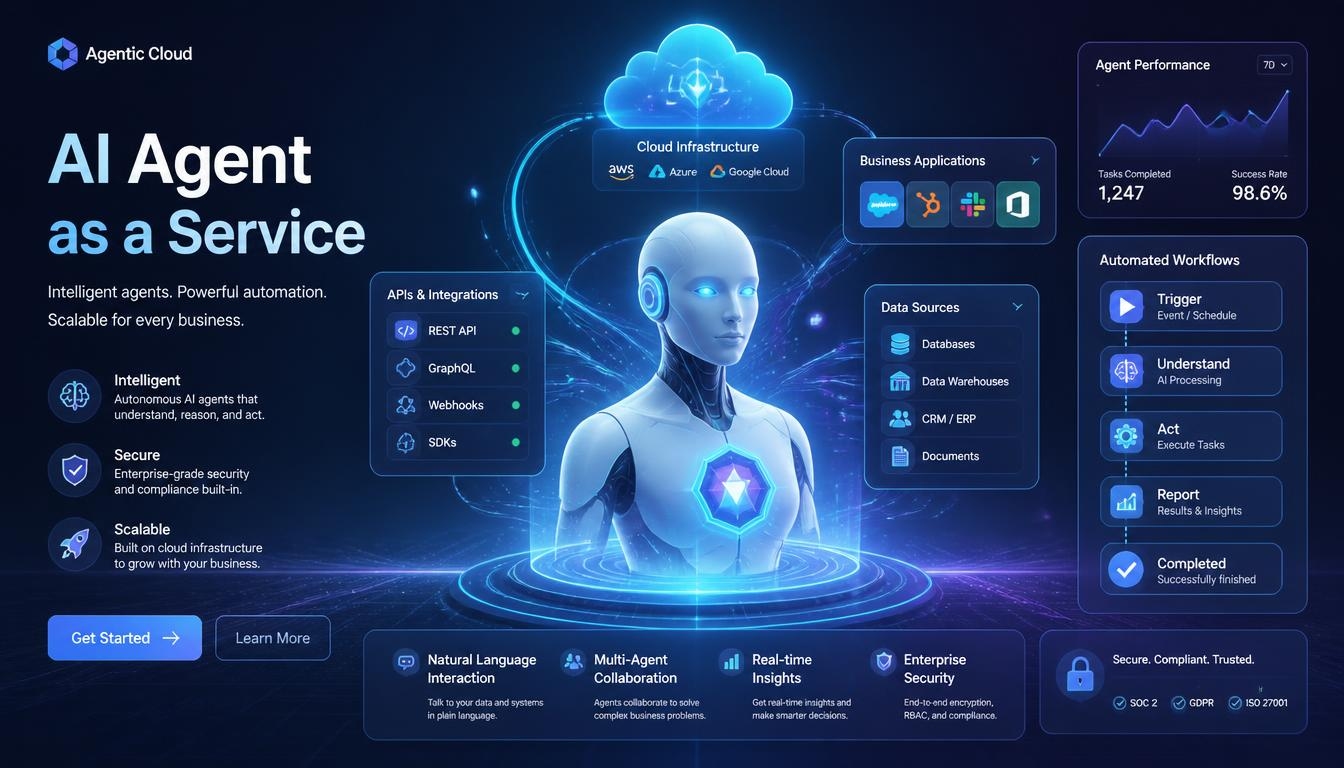
AI Agent as a Service (AIAaaS) is a delivery model in which AI agents are made available to businesses through a managed platform, subscription, or service arrangement.
Instead of developing an entire AI application internally, an organization can use an existing agent or commission a customized solution that is hosted, maintained, and supported by a service provider.
These agents can be configured to perform specific business responsibilities, such as processing customer enquiries, retrieving information, updating business records, preparing reports, or coordinating activities across connected applications.
For example, a company might use a managed AI sales assistant that receives enquiries from its website, extracts customer requirements, checks relevant information, and prepares records within its CRM.
The business receives the functionality without necessarily having to manage the underlying AI models, hosting infrastructure, integrations, and ongoing technical maintenance.
The exact scope depends on the provider. Some services offer standardized agents, while others provide customized solutions built around a company’s existing processes.
How AI Agent as a Service Works
An AI agent service generally combines several technical components into a managed application.
The AI model provides language understanding and reasoning capabilities, while the surrounding software determines which information the agent can access and which actions it is permitted to perform.
A typical implementation includes an interface through which users or connected systems submit requests, an orchestration layer that manages the workflow, integrations with relevant business applications, and monitoring mechanisms that track agent activity.
Consider a business using an AI agent to manage incoming customer enquiries.
When a request arrives, the agent may identify the nature of the enquiry, retrieve information from approved company resources, check relevant customer records, and prepare an appropriate response.
If the request falls within predefined operating rules, the system may complete the permitted action. More complicated situations can be escalated to a human employee.
The service provider may manage deployment, updates, model integrations, monitoring, and technical support, depending on the agreement.
This arrangement allows the organization to focus on how the agent supports its business rather than managing every technical component behind it.
AI Agent vs. Traditional Chatbot
Although AI agents and chatbots may use similar underlying language models, their responsibilities can be quite different.
A conventional chatbot primarily provides information through a conversational interface. It may answer frequently asked questions, guide visitors through a website, or retrieve information from a knowledge base.
An AI agent can go further by interacting with connected applications and performing permitted actions.
For example, a chatbot might explain a company’s appointment cancellation policy.
An AI agent could retrieve an appointment, check the cancellation conditions, submit a cancellation request, and update the relevant system when authorized.
The distinction is not simply conversational ability. It is the capacity to interact with business tools and complete defined workflows.
| Capability | Traditional Chatbot | AI Agent |
|---|---|---|
| Answering questions | Yes | Yes |
| Retrieving information | Depending on integration | Yes, when configured |
| Performing business actions | Usually limited | Through permitted tools |
| Multi-step workflows | Generally predefined | Can coordinate multiple steps |
| Integration with applications | Optional | Often central to its purpose |
| Human approval | Depends on implementation | Important for consequential actions |
Not every business requires an autonomous agent. For straightforward customer enquiries, a well-designed chatbot may be more economical and easier to maintain.
Where Businesses Can Use AI Agent as a Service
The practical value of AI agents becomes clearer when they are applied to recurring business activities.
Different industries have different requirements, but several use cases are relevant across organizations.
Customer Support
An AI customer support agent can retrieve information from approved documentation, check order details, organize incoming requests, and prepare responses.
When connected to customer service software, it may also classify tickets, update records, and route complex issues to the appropriate team.
This can help businesses manage routine enquiries more efficiently while maintaining human involvement in sensitive or unusual situations.
Sales and Lead Management
Sales teams often spend considerable time reviewing enquiries, collecting information, maintaining CRM records, and preparing follow-up communications.
An AI sales agent can assist with these activities by organizing lead information, identifying missing details, researching relevant business information, and preparing summaries for sales representatives.
It may also support follow-up workflows based on predefined business rules.
The objective is to reduce administrative work and allow sales teams to focus more attention on customer relationships and business development.
Document Processing
Businesses frequently work with contracts, invoices, policies, compliance documents, reports, and other structured or unstructured information.
An AI document processing agent can extract relevant details, classify files, compare document versions, and prepare information for review.
For example, an organization handling large volumes of compliance documentation could use an agent to identify missing information and highlight changes between submitted documents.
These capabilities can improve processing efficiency, although important findings should still be verified before being used in consequential decisions.
E-Commerce Operations
AI agents can support online retailers with catalogue management, order enquiries, product information, inventory monitoring, and customer service.
A connected agent might identify incomplete product listings, prepare missing descriptions, check inventory information, or assist customers with order-related requests.
More advanced implementations can coordinate activities across an e-commerce platform, CRM, inventory application, and support system.
Internal Business Administration
Administrative teams often perform repetitive activities involving information retrieval, reporting, scheduling, and record management.
AI agents can assist by organizing incoming requests, preparing summaries, generating routine reports, and updating approved business applications.
These systems are particularly useful when the work involves several connected tools and follows a reasonably consistent process.
Benefits of Using AI Agent as a Service
The main advantage of a managed AI agent service is that businesses can introduce automation without developing and maintaining every technical component internally.
However, the benefits depend on how well the service aligns with actual operational requirements.
Reduced Initial Development Requirements
A managed service can reduce the need to build infrastructure, orchestration systems, monitoring tools, and model integrations from the beginning.
This may shorten implementation time, particularly when the provider already supports the applications used by the business.
Predictable Service Management
Depending on the commercial arrangement, businesses may receive hosting, technical support, updates, and maintenance through an agreed service package.
This can simplify operational planning compared with managing multiple AI components independently.
Easier Expansion
An organization may begin with one agent supporting a specific department and introduce additional capabilities as requirements develop.
For example, a business could initially automate customer enquiry classification before extending the system to CRM updates and internal reporting.
Integration with Existing Software
A well-designed AI agent service can connect with the applications a company already uses.
This is important because replacing existing software is rarely necessary simply to introduce AI automation.
Reduced Repetitive Work
When implemented appropriately, AI agents can reduce the time employees spend retrieving information, preparing routine records, and moving data between systems.
Their value should be assessed through measurable improvements rather than assumptions about productivity.
AI Agent as a Service vs. Building a Custom AI Agent
Businesses considering AI automation often face an important decision: use a managed service or develop their own AI agent.
Both approaches have advantages.
| Consideration | Managed AI Agent Service | Custom AI Agent |
|---|---|---|
| Initial implementation | May be faster | Requires dedicated development |
| Customization | Depends on provider | Greater architectural control |
| Hosting | Usually provider-managed | Business or development partner-managed |
| Maintenance | Included according to agreement | Managed separately |
| Integrations | Supported or custom integrations | Designed around requirements |
| Data control | Depends on deployment model | Greater control when self-hosted |
| Pricing | Often recurring | Development plus operating costs |
| Scalability | Depends on service architecture | Depends on custom infrastructure |
A managed service may be suitable for organizations that want to introduce AI quickly and prefer ongoing technical support.
Custom development can be more appropriate when a business has specialized workflows, strict infrastructure requirements, or needs greater control over the application’s architecture.
The decision should consider the total cost of ownership, not just the initial implementation expense.
What Does AI Agent as a Service Cost?
There is no universal pricing model for AI agent services.
Costs vary according to the complexity of the agent, the underlying AI models, the number of integrations, expected usage, hosting requirements, and the level of customization.
Some providers offer fixed monthly subscriptions, while others combine an initial implementation charge with ongoing service fees.
Usage-based arrangements may charge according to AI model consumption, processed tasks, conversations, or other measurable activities.
Businesses should also consider expenses that may not be immediately visible, including integration development, data preparation, monitoring, support, and future modifications.
A low subscription price does not necessarily mean a lower overall cost if the system requires substantial manual supervision or cannot accommodate existing business processes.
Before selecting a service, organizations should understand what is included in the agreement and how charges may change as usage increases.
Security and Data Privacy Considerations
AI agents may interact with sensitive business information, customer records, internal documents, and connected applications.
This makes security an important part of the implementation rather than an optional feature.
Organizations should establish which information the agent can access, which actions it can perform, and how its activity will be monitored.
Access should follow the principle of least privilege, meaning the agent receives only the permissions required for its assigned responsibilities.
Businesses should also understand where information is processed and stored, whether external AI providers receive submitted data, and how retention policies are managed.
Actions involving payments, account changes, confidential records, or other consequential operations may require explicit human approval.
A managed service should provide clear information about these arrangements rather than expecting customers to assume that every AI integration is automatically secure.
Challenges of AI Agent as a Service
Although managed AI agents can simplify adoption, businesses should understand their limitations.
Reliability of AI Decisions
AI systems can misunderstand instructions, retrieve incomplete information, or produce incorrect outputs.
A production application needs validation procedures, error handling, and escalation mechanisms.
Dependence on External Providers
A managed service may depend on third-party AI models, cloud infrastructure, and external APIs.
Changes to pricing, service availability, or provider capabilities can affect the application.
Integration Complexity
Connecting an AI agent with existing business software may require more work than expected, particularly when older systems have limited APIs or inconsistent data.
Ongoing Monitoring
AI agents require continued evaluation after deployment.
Changes in business processes, application interfaces, and underlying AI models can influence how reliably an agent performs its responsibilities.
A managed service reduces some technical responsibilities, but it does not eliminate the need for business oversight.
How to Choose the Right AI Agent Service
Businesses should begin by identifying the process they want to improve rather than selecting a platform based only on its advertised AI capabilities.
A useful evaluation starts with understanding the existing workflow, the systems involved, and the outcome the business expects.
For example, a company seeking to reduce customer support workload should examine how many requests it receives, which questions are repetitive, and what information is required to resolve them.
The selected service should then be evaluated against these requirements.
Important considerations include integration capabilities, data protection, customization options, monitoring, technical support, pricing transparency, and the ability to introduce human approval where necessary.
A limited pilot using realistic business scenarios can help determine whether the service performs reliably before expanding its responsibilities.
The Future of AI Agent as a Service
As AI capabilities develop, managed agent services are likely to become more closely integrated with existing business applications.
Instead of operating as isolated assistants, agents may increasingly support connected workflows across customer service, sales, administration, document management, and other operational functions.
Businesses may also adopt multiple specialized agents rather than relying on one system to handle every responsibility.
For example, a sales agent could organize customer enquiries while a separate administrative agent manages internal reporting. Both could interact with shared business applications through controlled integrations.
However, broader automation also increases the importance of security, monitoring, accountability, and clear operating boundaries.
The long-term value of AI Agent as a Service will depend on whether providers can deliver dependable business functionality rather than simply offering access to increasingly capable language models.
Conclusion
AI Agent as a Service provides businesses with another way to introduce intelligent automation without building and maintaining every technical component internally.
From customer support and sales administration to document processing and e-commerce operations, managed AI agents can help organizations reduce repetitive work and improve coordination across existing software.
However, their value depends on selecting the right use cases, establishing appropriate controls, and evaluating the complete cost of implementation and operation.
Businesses should approach AI agents as practical software systems with defined responsibilities, not as replacements for every human role.
When developed and managed carefully, AI Agent as a Service can become a useful part of an organization’s wider digital infrastructure.