
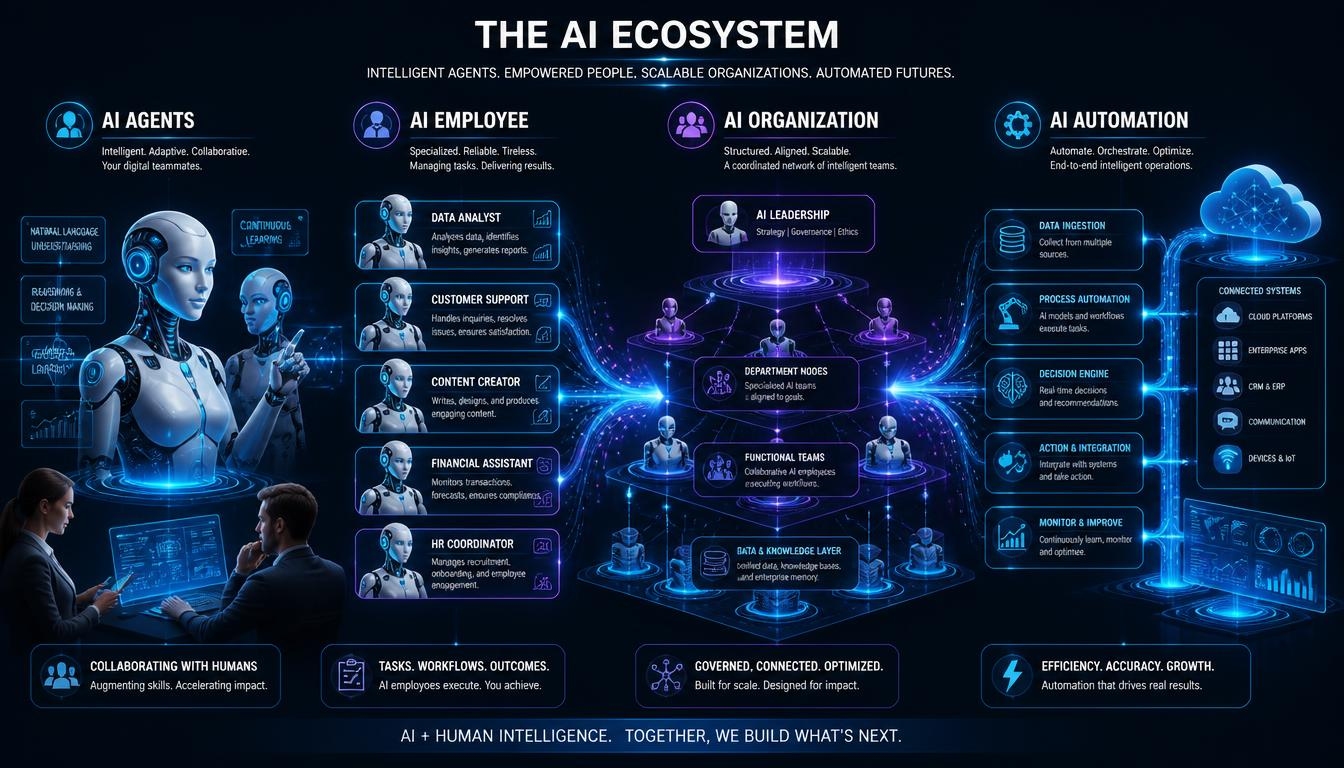
Understanding AI agents
An AI agent is a software system designed to work toward a defined goal. Depending on how it is built, it can interpret a request, gather information, use connected tools, perform a sequence of tasks, and determine what to do next within its permitted boundaries.
A conventional automation system usually follows a predefined workflow. An AI agent can handle some variation in the information it receives and choose between available actions based on context. This makes it useful for processes that involve documents, customer enquiries, research, or information spread across multiple systems.
For example, a sales support agent could review an incoming enquiry, extract the customer’s requirements, check relevant product information, prepare a response, and create a CRM record. Tasks that previously required several manual steps could be handled through one connected workflow.
However, an AI agent is not automatically reliable simply because it can perform multiple actions. Its results depend on the quality of the underlying model, the information available to it, the tools it can access, and the rules governing its decisions.
What is an AI employee?
An AI employee is a way of organizing AI capabilities around a specific business role rather than a single isolated task. It can be designed to support responsibilities such as customer support, sales research, administrative work, document processing, or internal knowledge management.
For example, an AI customer support employee might use several capabilities together. One component could classify incoming messages, another could retrieve information from company documentation, and another could draft a response based on the customer’s issue. The system could also record the interaction in a connected support platform.
The benefit comes from combining these capabilities into a consistent workflow with a defined purpose. Instead of asking employees to operate several separate AI tools, a business can provide a role-based interface that helps complete a recognizable set of responsibilities.
The term AI employee should not be confused with a human employee. An AI system does not independently possess human judgment, accountability, or an understanding of business relationships in the same way a person does. Its responsibilities, access, and authority need to be explicitly defined, with people remaining accountable for important decisions.
From individual agents to an AI organization
An AI organization takes the concept further by coordinating multiple AI agents or role-based AI systems across different business functions. Rather than automating one activity, the aim is to connect processes that depend on one another.
Consider a company that receives new customer enquiries through its website. A lead qualification agent could organize the incoming information, a research agent could gather relevant background details, and a sales support agent could prepare a summary for the sales team. A separate reporting process could update the CRM and highlight enquiries that need attention.
Each system has a defined responsibility, but the overall workflow connects their work. A human manager can review important outputs, resolve exceptions, and decide which opportunities deserve attention.
This is one possible model for an AI-driven organization. It does not necessarily mean operating a company without people. In many cases, the more practical approach is to let AI handle repeatable information-based work while people manage strategy, customer relationships, approvals, and decisions that require broader judgment.
Where businesses can use AI agents and AI employees
The most useful applications often begin with work that consumes time but follows a reasonably clear process. Businesses do not need to automate an entire department to see value. A well-designed system that handles one recurring bottleneck can be a better starting point.
Customer support and service operations
AI systems can classify support requests, retrieve answers from approved documentation, summarize conversations, and prepare responses for review. Where the process is sufficiently reliable, they can also resolve routine requests within clearly defined limits.
Complex complaints, sensitive information, and unusual cases should be escalated to a human rather than handled through unrestricted automation.
Sales and lead management
An AI sales assistant can organize incoming leads, summarize customer requirements, research relevant business information, prepare follow-up messages, and update CRM records. These capabilities help sales teams spend less time on administration and more time speaking with prospective customers.
Messages, pricing commitments, and other consequential actions should still follow the company’s approval rules.
Document processing and knowledge management
Many businesses spend considerable time reviewing contracts, policies, technical documents, compliance records, and internal procedures. AI agents can extract information, compare document versions, identify missing fields, and prepare summaries for employees.
For example, an AI-powered document management application could identify changes between two versions of a procedure and present them for review. The system would assist with the review process without assuming that every extracted detail or suggested change is correct.
Marketing and business research
AI agents can help organize research, group customer feedback, prepare content outlines, summarize campaign performance, and assemble reports from approved data sources.
These systems are particularly useful when the work involves gathering information from several places and producing a consistent output. Human review remains important for factual accuracy, brand voice, originality, and final publishing decisions.
Internal administration and reporting
Routine activities such as preparing meeting summaries, organizing requests, checking records for missing information, and generating operational reports can often be partially automated.
When connected to business applications, an AI system can move beyond producing text and help complete the surrounding workflow. The key is to make sure every action is traceable and that the system cannot modify important records outside its assigned permissions.
How AI agents, AI employees, and AI organizations work together
These concepts can be understood as different levels of business application rather than three completely separate technologies.
An AI agent performs a defined task or sequence of actions. An AI employee groups relevant capabilities around a business role. An AI organization coordinates multiple roles and workflows across the company.
A small business might begin with one agent that processes website enquiries. As its needs grow, it could develop a broader sales support system that handles qualification, research, and CRM updates. Eventually, it might connect sales, customer service, document processing, and reporting workflows into a coordinated operating model.
Not every company needs the third stage. The appropriate level depends on the volume of work, the complexity of its processes, the quality of its data, and the cost of maintaining the system.
What it takes to build a reliable AI system
Connecting an AI model to a few tools is not the same as building a dependable business application. A production-ready system needs to account for the complete workflow, including what happens when the AI is uncertain, information is missing, or a connected service fails.
Clear responsibilities and boundaries
Every agent should have a defined purpose, a limited set of permitted actions, and clear conditions for escalating work. Systems that can access customer records, send communications, or modify business data require particular care.
Integration with existing software
AI creates more practical value when it works with the applications a business already uses. Depending on the requirements, this could include a CRM, website, document repository, accounting platform, support system, or internal database.
The integration layer must handle authentication, permissions, validation, and failures rather than relying on the AI model alone.
Data protection and access control
AI systems should receive only the information necessary for their assigned responsibilities. Sensitive data needs appropriate protection, and organizations should understand how information is processed, stored, and shared with external services.
Activity logs, access reviews, and clear ownership are especially important when several agents interact with the same business systems.
Testing and human oversight
An AI workflow should be tested against ordinary requests, incomplete information, unexpected inputs, and situations where it should refuse to act. Its performance should be monitored after deployment, not just during development.
Actions involving payments, contractual commitments, sensitive customer information, or irreversible changes may require explicit human approval. The level of oversight should reflect the potential consequences of an error.
Start with a business problem, not the number of agents
It can be tempting to build several AI agents simply because the technology makes it possible. In practice, the better starting point is to identify a process that is expensive, repetitive, slow, or difficult to manage consistently.
Map the existing workflow, understand where employees spend their time, and determine which steps can be automated safely. Then measure the result using practical indicators such as processing time, error rates, staff workload, customer response times, and operating cost.
A simple workflow that performs reliably is often more valuable than a complicated network of agents that requires constant supervision. Additional capabilities can be introduced when there is a clear operational reason to do so.
The future of AI-driven business operations
AI agents and role-based AI systems are creating new ways to organize business work. Their long-term value will depend less on how human-like they appear and more on whether they can complete useful tasks accurately, integrate with existing systems, and operate within appropriate boundaries.
For some businesses, that may mean automating a single administrative process. For others, it may involve coordinating AI capabilities across sales, support, operations, and internal knowledge management. Both approaches can be worthwhile when they address a real need.
The practical goal is not to replace every employee or build an organization that runs entirely on AI. It is to make routine work more manageable, give people better information, and allow teams to focus on the responsibilities where their experience and judgment matter most.