
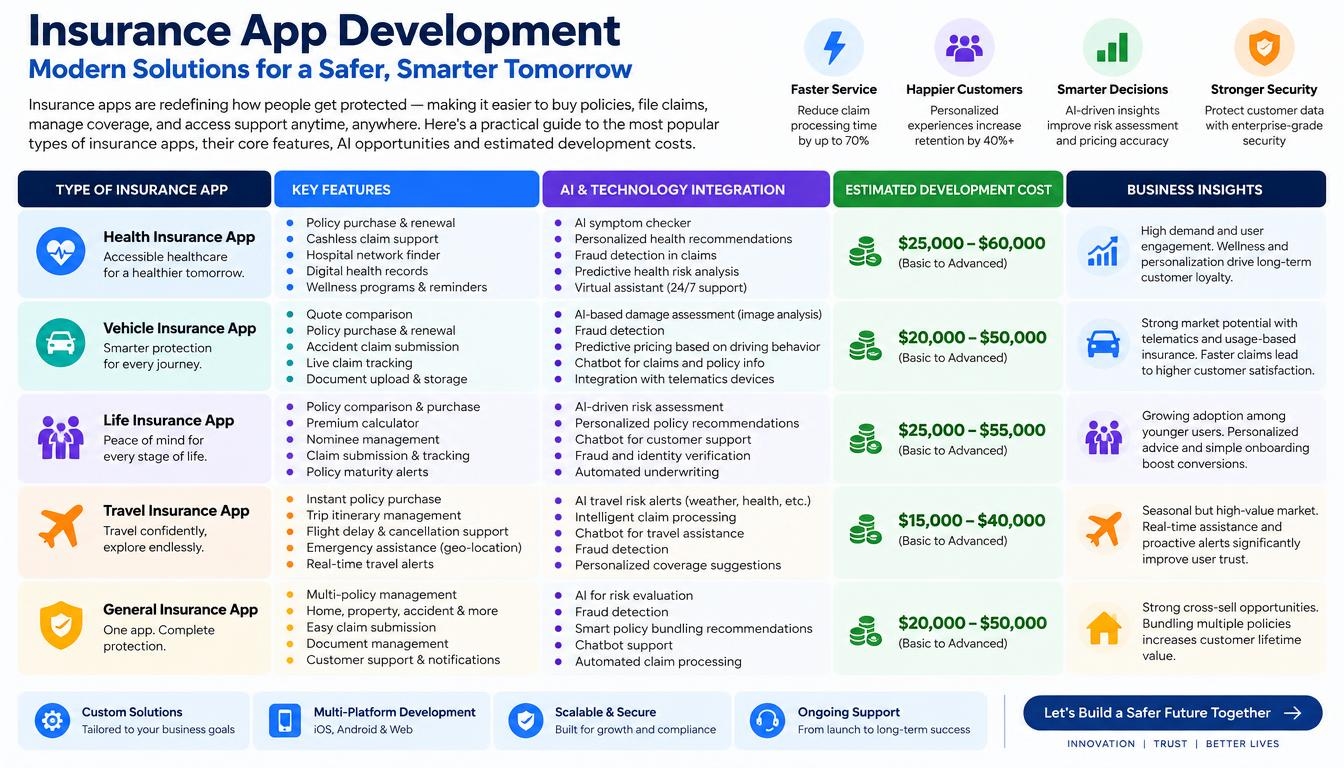
1. What Is an Insurance Application?
An insurance application is a web or mobile platform that allows customers, insurance providers, brokers, agents and administrators to manage insurance-related activities digitally.
Depending on its business model, an insurance app may allow users to:
- Explore and compare insurance policies.
- Calculate premiums and request quotations.
- Purchase insurance policies online.
- Upload identity and supporting documents.
- Make premium payments and manage renewals.
- Access policy information and documents.
- Register and track insurance claims.
- Communicate with customer support or insurance agents.
- Manage customers, policies, payments and claims through an administration portal.
A complete insurance platform may include multiple connected applications, such as a customer mobile app, agent dashboard, broker portal, insurer administration panel and backend integration services.
The first step in development is therefore identifying which insurance business model the application will support.
2. Major Types of Insurance Applications
Different insurance categories require different features, business rules and integrations.
2.1 Health Insurance Applications
Health insurance applications help individuals and families explore health coverage, purchase policies, manage benefits and submit medical claims.
Common features:
- User registration and profile management.
- Individual and family health insurance plans.
- Policy comparison and premium calculation.
- Hospital and healthcare provider directories.
- Digital policy documents.
- Cashless hospitalization information.
- Medical document uploads.
- Claim registration and status tracking.
- Renewal notifications.
- Customer support and assistance.
Advanced functionality:
- Hospital network integration.
- Electronic health record integrations, where authorized.
- Medical bill and prescription document extraction.
- Claim eligibility workflow support.
- Pre-authorization request management.
- Health plan recommendations based on customer requirements.
Example: A customer purchases a family health insurance policy, downloads the policy document, searches for a network hospital and submits a hospitalization claim through the application.
2.2 Motor and Vehicle Insurance Applications
Motor insurance apps are designed for vehicle owners, insurance companies and agents. They support vehicle insurance quotations, policy purchases, renewals and accident-related claims.
Common features:
- Vehicle registration details.
- Vehicle information and document uploads.
- Insurance plan comparison.
- Premium calculation.
- Third-party and comprehensive coverage options.
- Online policy purchase and renewal.
- Digital insurance certificates.
- Accident reporting.
- Claim submission and tracking.
- Repair workshop information.
- Payment gateway integration.
Advanced functionality:
- Vehicle damage assessment using photographs.
- Image-based inspection.
- Repair cost estimation.
- Integration with vehicle databases where permitted.
- Telematics and driving behaviour data.
- Fraud pattern identification.
Example: A vehicle owner reports an accident, uploads photographs of the damaged vehicle and receives claim status updates through the application.
2.3 Life Insurance Applications
Life insurance applications focus on long-term financial protection, policy management and premium payments.
Common features:
- Life insurance plan information.
- Coverage and premium calculators.
- Customer onboarding.
- Nominee and beneficiary management.
- Identity verification.
- Medical questionnaire workflows.
- Policy purchase and document access.
- Premium payment and renewal.
- Policy maturity information.
- Claim registration and tracking.
Advanced functionality:
- AI-assisted document processing.
- Customer eligibility assessment support.
- Personalized policy recommendations.
- Automated customer communication.
- Risk assessment support for underwriting teams.
Life insurance applications may require more complex workflows because policy issuance can involve medical information, eligibility assessment and additional verification.
2.4 Travel Insurance Applications
Travel insurance applications provide coverage for people travelling domestically or internationally.
Common features:
- Destination and travel-date selection.
- Traveller information.
- Single-trip and multi-trip policies.
- Coverage comparison.
- Premium calculation.
- Online policy purchase.
- Digital policy certificates.
- Emergency assistance information.
- Medical and baggage claim registration.
- Flight cancellation and delay claim workflows.
Advanced functionality:
- Integration with flight and travel booking systems.
- Travel disruption notifications.
- AI-powered customer assistance.
- Automated document extraction for claims.
- Multilingual support.
2.5 Property and Home Insurance Applications
Property insurance apps help homeowners, tenants, landlords and businesses protect buildings and valuable assets.
Common features:
- Property registration.
- Property details and valuation inputs.
- Coverage selection.
- Premium calculation.
- Property inspection scheduling.
- Document and photograph uploads.
- Policy management.
- Damage reporting.
- Claim tracking.
- Renewal notifications.
Advanced functionality:
- Computer vision for property damage assessment.
- Image-based asset documentation.
- Weather and location risk data integration.
- Risk analysis support.
- Automated claim document processing.
2.6 Commercial and Business Insurance Applications
Commercial insurance platforms serve businesses that need protection for property, equipment, employees, vehicles, liability and other business risks.
Common features:
- Business registration and verification.
- Company profile management.
- Employee and asset information.
- Commercial policy quotations.
- Multiple coverage options.
- Document management.
- Quote and proposal generation.
- Broker and agent communication.
- Policy renewal management.
- Claims and incident reporting.
Advanced functionality:
- Multi-location policy management.
- Business risk assessment support.
- Integration with accounting and ERP systems.
- Automated certificate generation.
- AI-assisted risk document analysis.
- Enterprise reporting and analytics.
2.7 Insurance Broker and Aggregator Applications
An insurance broker or aggregator platform allows customers to explore insurance products from multiple providers through one digital interface.
This model is particularly useful for insurance marketplaces and distribution businesses.
Common features:
- Multiple insurance provider listings.
- Policy comparison.
- Premium and coverage comparison.
- Customer registration.
- Lead management.
- Quote requests.
- Online purchase workflows.
- Agent and broker dashboards.
- Commission management.
- Customer support.
- Policy renewal tracking.
Advanced functionality:
- Multiple insurer API integrations.
- Automated quote collection.
- AI-assisted product recommendations.
- Lead scoring.
- Automated follow-ups.
- Sales and commission analytics.
A major development challenge for this model is integrating different insurance providers. Each provider may have its own API structure, quotation rules, documentation requirements and policy issuance process.
3. Essential Features of a Complete Insurance Application
Although each insurance category has different requirements, most insurance platforms share several core modules.
Customer Application
The customer-facing application should provide a simple experience for discovering, purchasing and managing insurance.
Important modules include:
- Registration and secure login.
- Customer profile and personal information.
- Insurance product catalogue.
- Policy comparison.
- Quotation and premium calculator.
- Online payment.
- Policy purchase and document access.
- Claims registration.
- Claim status tracking.
- Renewal reminders.
- Notifications and customer support.
Insurance Agent or Broker Dashboard
If the business operates through agents or brokers, a separate dashboard can help manage customers and sales activities.
It may include:
- Agent registration and approval.
- Customer lead management.
- Quote creation.
- Policy recommendations.
- Customer document collection.
- Application tracking.
- Commission calculation.
- Renewal follow-ups.
- Performance reports.
Admin Dashboard
The administration portal manages the overall insurance business.
Typical modules include:
- Customer management.
- Insurance product management.
- Policy management.
- Agent and broker management.
- Claims management.
- Payment and commission tracking.
- Document management.
- Reports and analytics.
- Notification management.
- User roles and permissions.
- Audit logs and system configuration.
Claims Management System
Claims management is one of the most important parts of an insurance platform.
A typical workflow includes:
- Customer submits a new claim.
- Application collects relevant information and supporting documents.
- The system generates a claim reference number.
- The claim is assigned to the appropriate team.
- Documents and policy details are verified.
- The claim is reviewed against the applicable policy conditions.
- Additional information is requested if required.
- An authorized person approves, rejects or requests further review.
- The customer receives an update.
- Payment or settlement is processed through the appropriate workflow.
The exact process varies by insurance category and provider.
4. How Artificial Intelligence Is Transforming Insurance Applications
AI can improve several stages of the insurance lifecycle, from customer onboarding to claims management.
According to insurance industry guidance and research, major application areas include underwriting, pricing, customer service, fraud detection and claims processing. However, AI needs appropriate data, monitoring and human oversight, particularly when it influences decisions affecting customers.
4.1 AI-Powered Insurance Chatbots
An AI chatbot can provide assistance to customers at any time.
It can:
- Explain insurance products and coverage.
- Answer frequently asked questions.
- Help customers find relevant policies.
- Explain renewal procedures.
- Guide customers through claim registration.
- Provide updates from connected claim systems.
- Assist with document submission.
For example, a customer could ask, “What documents do I need to submit for a motor insurance claim?”
The chatbot can retrieve the relevant information from approved insurance documentation and provide a clear response.
A more advanced AI assistant can connect to the application backend to retrieve policy or claim information after verifying the customer’s identity and permissions.
4.2 AI-Based Document Processing
Insurance applications handle a large volume of documents, including identity documents, medical reports, vehicle registration certificates, invoices and claim forms.
AI-powered document processing can:
- Identify document types.
- Extract relevant information.
- Read names, dates and policy numbers.
- Extract invoice amounts.
- Identify missing information.
- Classify uploaded documents.
- Convert unstructured documents into structured data.
For example, when a customer uploads a hospital invoice, the system can extract the hospital name, invoice date and total amount and prepare the information for review.
The extracted data should be validated before it is used in important policy or claim decisions.
4.3 AI-Assisted Claims Processing
Claims processing often involves reviewing documents, checking policy information and coordinating with different teams.
AI can help by:
- Categorizing incoming claims.
- Extracting information from claim documents.
- Identifying missing documents.
- Summarizing claim histories.
- Prioritizing cases for review.
- Comparing submitted information with relevant policy records.
- Supporting damage assessment through image analysis.
For motor insurance, computer vision can help identify visible vehicle damage from photographs and provide an initial repair estimate.
For health insurance, AI can assist with document classification and information extraction.
These capabilities can reduce manual data entry, but final claim decisions should follow the insurer’s approved rules and review process.
4.4 AI-Based Fraud Detection
Fraud detection is another important application of AI in insurance.
Machine learning models can analyze historical data and identify patterns that may require investigation.
Examples include:
- Repeated claims involving similar information.
- Unusual claim submission patterns.
- Inconsistent documents.
- Duplicate invoices.
- Suspicious vehicle damage patterns.
- Unusual relationships between claims and service providers.
The system can generate a risk score or flag a case for investigation.
An AI-generated fraud score should be treated as an investigation signal, not automatic proof of fraud.
4.5 AI-Powered Insurance Recommendations
An insurance platform can use AI to help customers understand available coverage options.
For example, a customer looking for family health insurance may provide information about:
- Number of family members.
- Age groups.
- Desired coverage amount.
- Preferred hospitals.
- Budget.
- Additional coverage requirements.
The system can use these requirements to shortlist suitable products from an approved catalogue.
Recommendations should be based on accurate policy information and transparent eligibility rules. AI should not invent coverage benefits or policy conditions.
4.6 AI-Assisted Underwriting and Risk Assessment
Underwriting involves evaluating the risk associated with providing insurance coverage.
AI can support underwriters by:
- Organizing customer application information.
- Extracting information from supporting documents.
- Identifying missing or inconsistent details.
- Summarizing historical information.
- Highlighting patterns for further investigation.
- Supporting risk classification workflows.
The model’s use must be carefully governed. Insurance pricing and eligibility decisions can have significant consequences, so fairness, explainability, data quality and human review are important.
4.7 Predictive Analytics
AI can also help insurance businesses understand future patterns.
Possible applications include:
- Identifying customers who may need renewal reminders.
- Forecasting claim volumes.
- Analyzing customer retention.
- Identifying unusual claim trends.
- Supporting customer service planning.
- Analyzing risk patterns across portfolios.
These insights can help management make better operational decisions.
5. Recommended Technology Stack for Insurance App Development
The technology stack depends on the application’s scale, expected traffic, integration requirements and business model.
For a modern insurance platform, the following architecture is a practical starting point.
| Application layer | Recommended technologies |
|---|---|
| Web frontend | React.js, Next.js, TypeScript |
| Mobile applications | React Native or Flutter |
| Backend APIs | Node.js with NestJS |
| AI and machine learning | Python, FastAPI, ML frameworks and model APIs |
| Database | PostgreSQL |
| Caching | Redis |
| Background processing | Message queues and worker services |
| Document storage | AWS S3 or compatible object storage |
| Cloud infrastructure | AWS, Azure or Google Cloud |
| Deployment | Docker, CI/CD and cloud monitoring |
| External integrations | Payment, identity verification, insurer and notification APIs |
Why This Architecture?
React and Next.js: Suitable for customer portals, insurance marketplaces, broker dashboards and administration interfaces.
React Native or Flutter: Useful when a business needs mobile applications for both Android and iOS.
Node.js and NestJS: Provide a structured backend for customer management, policies, payments, claims and integrations.
Python and FastAPI: Suitable for AI services, document processing, data analysis and machine learning integrations.
PostgreSQL: Provides reliable relational data management for customers, policies, payments and claims.
Redis and message queues: Help handle caching, notifications, scheduled tasks and background processing.
A modular architecture allows different services to scale independently as the business grows.
6. Suggested Architecture of an Insurance Platform
A full insurance platform can be divided into several connected layers.
1. Presentation layer
- Customer web application.
- Android and iOS applications.
- Agent and broker portal.
- Admin dashboard.
2. Backend application layer
- Authentication and access control.
- Customer management.
- Insurance product catalogue.
- Quotation and policy services.
- Payment processing.
- Claims management.
- Notification services.
3. Integration layer
- Insurance provider APIs.
- Payment gateways.
- Identity verification services.
- Email and SMS providers.
- Hospital or vehicle service integrations.
- Accounting and CRM systems.
4. AI and analytics layer
- AI chatbot.
- Document extraction.
- Claims classification.
- Fraud detection support.
- Recommendation engine.
- Business analytics.
5. Data and infrastructure layer
- Relational database.
- Secure document storage.
- Caching.
- Background workers.
- Monitoring and logging.
- Backup and disaster recovery.
A key architectural decision is to keep business rules and policy data separate from AI services. AI can assist with information processing, but the platform should use controlled business logic and authorized workflows for important insurance operations.
7. Insurance App Development Cost: From MVP to Full Product
One of the first questions founders and insurance businesses ask is: How much does it cost to develop an insurance application?
There is no single price because the cost depends on the type of insurance, number of applications, complexity of policy workflows, integrations, security requirements and AI functionality.
The following figures are indicative 2026 planning estimates for a development team based in India, not fixed market prices or vendor quotations.
7.1 Insurance App MVP
<text>MVP estimated budget: ₹12 lakh – ₹25 lakh</text>
<text>Typical development time: 10–16 weeks</text>
An MVP is suitable for startups and businesses that want to validate an insurance business model before investing in a larger platform.
Typical MVP features:
- Customer registration and login.
- Basic customer profiles.
- One insurance category.
- Insurance product listings.
- Basic quotation or lead request workflow.
- Policy information pages.
- Document uploads.
- Admin dashboard.
- Basic notifications.
- Payment integration, if required.
For example, a startup may launch a motor insurance comparison platform with a limited number of insurance providers and a quotation request workflow.
The goal is to validate customer demand and operational workflows before building more advanced features.
7.2 Mid-Level Insurance Application
<text>Estimated budget: ₹25 lakh – ₹55 lakh</text>
<text>Typical development time: 4–7 months</text>
This stage is suitable for a business that needs more complete insurance operations.
Typical features:
- Customer web application.
- Android and iOS applications.
- Agent or broker dashboard.
- Multiple insurance products.
- Advanced quotation workflows.
- Payment and renewal management.
- Claims registration and tracking.
- Document management.
- Multiple third-party integrations.
- Reports and analytics.
- Role-based access control.
At this stage, the platform moves beyond basic lead generation and supports more of the customer and operational lifecycle.
7.3 Advanced Insurance Platform
<text>Estimated budget: ₹55 lakh – ₹1.2 crore</text>
<text>Typical development time: 6–10 months</text>
An advanced insurance platform may support multiple products, providers, customer groups and complex workflows.
Typical features:
- Multiple insurance categories.
- Customer web and mobile applications.
- Agent, broker and admin portals.
- Multiple insurance provider integrations.
- Advanced policy management.
- Automated claims workflows.
- Commission and payment management.
- Customer segmentation.
- Advanced reporting.
- AI-powered document processing.
- AI chatbot.
- Fraud detection support.
- Workflow automation.
- Enterprise security and audit capabilities.
7.4 Enterprise Insurance Platform
<text>Estimated budget: ₹1.2 crore – ₹3 crore or more</text>
<text>Typical development time: 9–18 months or longer</text>
This category is suitable for large insurance businesses, established providers and enterprises requiring extensive operational capabilities.
Potential features:
- Multiple insurance lines.
- Complex underwriting workflows.
- Policy administration capabilities.
- Claims management at scale.
- Enterprise integrations.
- Advanced agent and broker management.
- Data warehouse and analytics.
- AI-assisted risk assessment.
- Advanced fraud detection.
- Multi-region infrastructure.
- Disaster recovery.
- Extensive security and compliance controls.
- Enterprise reporting and audit trails.
A platform replacing an insurer’s existing core policy administration or claims systems can exceed these estimates significantly, especially when legacy data migration and complex integrations are involved.
Development Cost Comparison
| Development stage | Estimated budget | Indicative timeline |
|---|---|---|
| MVP | ₹12L–₹25L | 10–16 weeks |
| Mid-level | ₹25L–₹55L | 4–7 months |
| Advanced | ₹55L–₹1.2Cr | 6–10 months |
| Enterprise | ₹1.2Cr–₹3Cr+ | 9–18+ months |
These estimates assume custom development and a reasonably defined scope. They do not automatically include insurance licensing, regulatory approvals, insurer API access charges, actuarial consulting, large-scale data migration or third-party enterprise software licences.
8. How Much Does AI Integration Add to Insurance App Development Cost?
AI integration costs depend on the use case, data availability and whether the application uses existing AI APIs or requires custom machine learning models.
Indicative additional development budgets:
| AI functionality | Estimated additional cost |
|---|---|
| AI chatbot using an existing model API | ₹2L–₹5L |
| AI document extraction | ₹3L–₹7L |
| AI-assisted customer recommendations | ₹3L–₹8L |
| AI claims classification and assistance | ₹5L–₹12L |
| Image-based vehicle damage assessment | ₹8L–₹20L+ |
| Custom fraud detection model | ₹10L–₹25L+ |
These are indicative project-development estimates. They are not recurring AI usage charges and should not be added blindly to every project.
For example, a startup may initially need only an AI chatbot and document extraction. A large insurer may need custom models trained and evaluated using historical claims data.
AI API Costs and Ongoing Expenses
Apart from initial development, AI services can introduce recurring costs.
These may include:
- AI model API usage.
- Document processing services.
- Cloud computing.
- Data storage.
- Model monitoring.
- Third-party data services.
- Security and maintenance.
The actual monthly expense depends on the number of users, document volume, AI requests, model selection and processing requirements.
For an MVP, it is often more practical to use established AI services rather than develop and maintain custom models from the beginning.
9. Factors That Affect Insurance App Development Costs
Several factors can significantly change the final project budget.
1. Number of insurance categories
A platform supporting one insurance category is generally simpler than one supporting health, life, motor, travel and commercial insurance.
Each category has different quotation, eligibility, policy and claims workflows.
2. Number of third-party integrations
Integrating with multiple insurance providers, payment gateways, identity verification services and external business systems increases development and testing requirements.
3. Mobile and web applications
A web-only MVP generally costs less than a platform requiring separate customer, agent and administrator applications across web and mobile.
4. Policy and claims complexity
Simple quotation and lead management are different from complete policy issuance, underwriting, renewals and claims settlement workflows.
5. AI functionality
A basic chatbot is significantly different from a custom AI model that analyzes thousands of historical claims.
6. Security and regulatory requirements
Insurance applications handle sensitive customer and financial information. Access control, encryption, audit logs, data retention, secure integrations and security testing must be included in the development plan.
7. Existing systems and legacy migration
Connecting a new application to an existing insurer platform can require substantial integration and data migration work.
10. Security, Compliance and Data Protection
Security should be considered from the beginning of insurance app development rather than added after the application is complete.
Important considerations include:
- Secure authentication and authorization.
- Role-based access control.
- Encryption of sensitive information.
- Secure document storage.
- API authentication and access restrictions.
- Audit logs for important actions.
- Regular vulnerability assessments.
- Backup and disaster recovery.
- Data retention and deletion policies.
- Monitoring and incident response.
Regulatory requirements depend on the country, the type of insurance business and the organization’s role.
For example, businesses operating in India must assess applicable IRDAI requirements and the relevant rules for insurers and insurance intermediaries. In the United States, insurance regulation also involves state-level requirements. Privacy and data protection obligations must be evaluated for every target market.
AI systems require additional controls. Businesses should consider model validation, data quality, bias testing, explainability, monitoring and human review of consequential decisions.
An application that distributes or sells insurance may also require specific regulatory authorization. Building the technology alone does not provide permission to operate as an insurer, broker or other regulated intermediary.
11. Step-by-Step Process to Build an Insurance Application
A structured development process helps reduce unnecessary features, control costs and avoid architectural problems.
Step 1: Define the Business Model
Identify whether the application will be:
- A direct insurance provider platform.
- A broker or agent application.
- An insurance comparison marketplace.
- A claims management system.
- A customer policy management application.
- A specialized insurance SaaS product.
Step 2: Identify the Target Insurance Category
Select the initial insurance category, such as health, motor, life or travel.
Starting with one category can help simplify the first release.
Step 3: Prepare the MVP Feature List
Identify the essential customer, admin and operational workflows.
Separate must-have features from future enhancements.
Step 4: Design the User Experience
Prepare user journeys, application screens, dashboard layouts and navigation.
Insurance applications should make policy information, coverage details and claim procedures easy to understand.
Step 5: Plan the Architecture and Integrations
Select the technology stack, database structure, backend services, cloud infrastructure and third-party integrations.
Confirm API access and integration requirements before committing to a delivery timeline.
Step 6: Develop the Core Platform
Build the customer application, backend APIs, administration portal and essential business workflows.
Step 7: Integrate Payments and External Services
Connect payment gateways, identity verification, notification providers and insurance company APIs where available and authorized.
Step 8: Add AI Functionality
Start with clearly defined use cases such as customer support, document extraction or claim classification.
Evaluate the accuracy and reliability of the AI features before using them in production.
Step 9: Test Security and Business Workflows
Test policy purchase, payment processing, document uploads, renewals, claims, access permissions and external integrations.
Perform appropriate security and performance testing before launch.
Step 10: Launch and Improve
Release the MVP, collect customer feedback, monitor application performance and prioritize the next development phase.
12. How Xenixsoft Can Help Build an Insurance Application
Building an insurance application requires more than developing a mobile interface. The platform must connect customer-facing functionality with backend workflows, external services, secure document management and business operations.
Xenixsoft can help businesses plan and develop custom insurance applications based on their specific business model.
Our development approach can include:
- Business requirement analysis: Understand the insurance category, target customers, business model and operational requirements.
- MVP planning: Identify the essential features needed for the first release and prepare a phased development roadmap.
- UI/UX design: Design customer applications, agent portals and administration dashboards.
- Custom application development: Develop web and mobile interfaces, backend APIs and database architecture.
- Third-party integrations: Connect payment gateways, identity verification services, insurer APIs and other external systems where access is available.
- AI development: Integrate AI chatbots, document processing, workflow assistance and other suitable AI capabilities.
- Testing and deployment: Validate application workflows, integrations, security and performance before production launch.
- Ongoing maintenance: Provide technical support, improvements, integrations and future feature development.
Whether a business wants to launch a small insurance MVP or develop a more comprehensive digital insurance platform, the development scope should be planned around its actual operational needs and future growth.
13. Final Thoughts
Insurance applications are becoming an important part of the digital insurance ecosystem. From health and motor insurance to broker marketplaces and enterprise insurance platforms, each application type solves a different business problem.
AI can make these platforms more efficient by assisting with customer support, document processing, claims workflows, fraud detection and risk analysis. However, successful implementation requires reliable data, secure architecture, proper governance and human oversight.
For startups, beginning with a focused MVP is often the most practical approach. It allows the business to validate its model, test customer demand and build a foundation that can be expanded into a complete insurance product.
The right application architecture, technology stack and development roadmap can make the difference between a basic insurance app and a scalable digital insurance platform.