
What Is Decoupled Drupal?
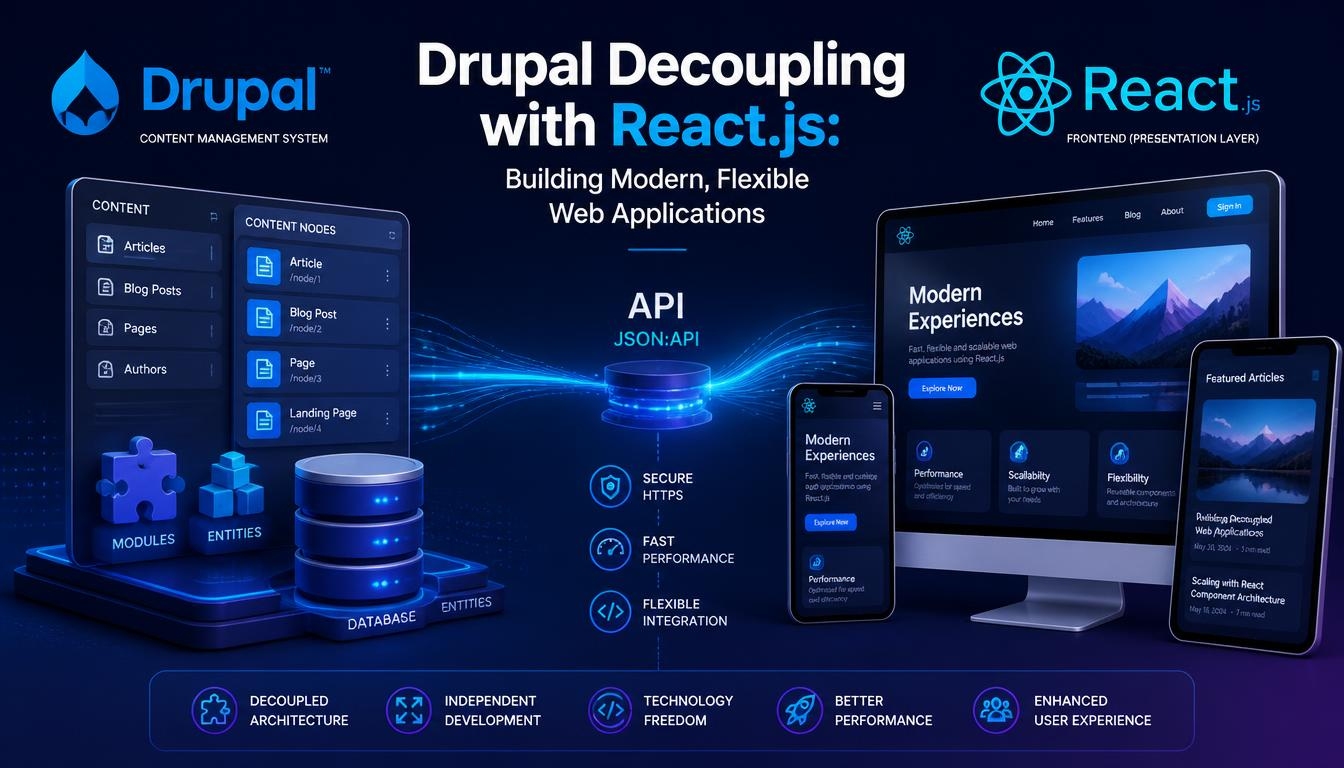
Decoupled Drupal, often referred to as headless Drupal, is an architecture in which Drupal operates primarily as a backend content management system while a separate application handles the frontend presentation.
In a traditional Drupal website, content management and page rendering are closely connected. Drupal retrieves content, processes it through its rendering system, and delivers the resulting pages to visitors.
In a decoupled implementation, Drupal exposes content through APIs. An independent frontend application retrieves that information and determines how it should be displayed.
This separation allows businesses to continue using Drupal for structured content, editorial workflows, user permissions, and backend functionality without requiring the frontend to use Drupal’s traditional theme layer.
React.js is one of the technologies developers can use to build this independent frontend.
Why Use React.js with Drupal?
React.js is a JavaScript library designed for building user interfaces using reusable components.
Its component-based approach is particularly useful for applications that require frequent interface updates, complex interactions, and consistent visual elements across multiple sections.
When React is combined with Drupal, the responsibilities can be divided according to the strengths of each technology.
Drupal manages content and backend operations, while React controls the user-facing experience.
For example, a business could maintain product information, articles, customer resources, and other structured content through Drupal. React would retrieve the required information and display it through a separately developed frontend.
This allows frontend developers to build interactive experiences without depending entirely on Drupal’s traditional rendering and templating system.
It also enables backend and frontend teams to work with a greater degree of independence, provided the API structure and integration requirements are clearly defined.
How Drupal and React.js Work Together
A decoupled Drupal application generally consists of three main components: the Drupal backend, an API communication layer, and the React frontend.
Each component has a specific responsibility within the overall architecture.
Drupal as the Backend CMS
Drupal remains responsible for creating, organizing, and managing content.
Its content types, fields, taxonomies, media management, user permissions, and publishing workflows provide the foundation for the application.
Content administrators can continue working through Drupal’s administrative interface while frontend developers build the presentation layer separately.
Drupal may also manage custom business logic and integrations with external applications, depending on the project’s requirements.
API-Based Communication
The connection between Drupal and React is typically established through APIs.
Drupal provides JSON as part of its core functionality, allowing appropriately configured content and entity information to be accessed through standardized endpoints.
Developers may also use GraphQL through contributed solutions or create custom API endpoints when the project requires more specialized functionality.
These APIs allow the React application to request content from Drupal without relying on Drupal to render the complete page.
React.js as the Frontend
React receives information from Drupal and presents it through reusable interface components.
These components might include navigation elements, article layouts, product cards, search interfaces, dashboards, and interactive forms.
The frontend can also communicate with other services where necessary, provided authentication, permissions, and data handling are implemented correctly.
The result is a system in which content management and frontend development remain connected through APIs while operating as separate application layers.
Benefits of Decoupling Drupal with React.js
Decoupling can provide several advantages, particularly for projects that require extensive frontend customization or content delivery across different platforms.
Greater Frontend Flexibility
A separate React application gives developers more freedom to design and implement the user interface.
They are not required to build every frontend interaction through Drupal’s traditional theme and rendering systems.
This can be particularly useful for complex applications involving dynamic content, interactive dashboards, advanced filtering, or customized user experiences.
Reusable Frontend Components
React allows developers to organize interfaces into reusable components.
A component created for displaying a product, article, or customer record can be used across multiple sections of an application.
This helps maintain visual consistency and can reduce duplicated frontend development work.
Independent Development and Deployment
Separating Drupal and React allows development teams to manage their respective application layers independently.
Frontend changes may be deployed without modifying Drupal’s theme layer, while backend developers can work on content structures and business functionality.
However, changes to API contracts must still be coordinated to prevent compatibility issues between the two systems.
Content Delivery Across Multiple Platforms
One of the important advantages of headless Drupal is the ability to expose structured content through APIs.
The same Drupal installation can potentially provide content to a website, mobile application, customer portal, or another digital platform.
Each application can present that information according to its own interface requirements.
Support for Interactive Applications
React is particularly useful when a website includes application-like functionality.
Features such as dynamic search, product configurators, multi-step forms, personalized dashboards, and interactive data presentation can be developed through its component-based architecture.
This makes Drupal and React a practical combination for projects that need both structured content management and substantial frontend interaction.
Practical Applications of Drupal and React Decoupling
The architecture can be applied to different types of websites and business applications.
E-Commerce Platforms
An e-commerce business may use Drupal to manage product-related content, customer information, administrative workflows, and backend integrations.
React can provide a customized storefront with interactive product listings, filtering, product comparison, and other shopping features.
For projects using Drupal Commerce, developers must also plan how cart operations, checkout, authentication, pricing, and order management will communicate with the decoupled frontend.
Enterprise Websites
Organizations managing large volumes of structured content can use Drupal as a centralized content management platform.
A React frontend can then provide a customized presentation layer while other applications consume relevant content through APIs.
This is particularly useful when content needs to be distributed across several digital channels.
Customer Portals
Businesses developing customer-facing portals may require interactive dashboards, account information, documents, service requests, and reporting interfaces.
Drupal can manage structured information and permissions, while React provides the interface through which users interact with the system.
Custom Web Applications
Decoupled Drupal can also support applications involving booking management, registration systems, marketplaces, and other custom business processes.
In these cases, Drupal provides backend capabilities while React is used to develop a frontend tailored to the application’s specific requirements.
Important Considerations Before Decoupling Drupal
Although decoupling provides flexibility, it also introduces responsibilities that are handled differently in a traditional Drupal implementation.
These considerations should be addressed during the initial planning stage.
Search Engine Optimization
A decoupled frontend requires an appropriate rendering strategy to support search engine visibility and page performance.
A React application that relies entirely on client-side rendering may create additional challenges for content discovery and initial page loading.
Depending on the project, developers may consider server-side rendering or static generation through a React-based framework such as Next.js.
Page metadata, canonical URLs, structured data, XML sitemaps, and content updates must also be managed appropriately.
Content Preview and Editorial Experience
Drupal provides established tools for content creation, revision management, and publishing.
In a decoupled implementation, content previews and visual editing capabilities may require additional integration with the frontend.
Businesses should ensure that content editors can preview unpublished changes and manage their work without unnecessary technical involvement.
Authentication and Security
When Drupal and React operate as separate applications, authentication and authorization require careful planning.
API access must respect Drupal’s permission system, and sensitive operations should be protected through appropriate authentication, access controls, and request validation.
The frontend should never be treated as the sole mechanism for enforcing security.
Performance and Caching
Decoupling does not automatically make a website faster.
Performance depends on factors such as API response times, frontend rendering, caching strategies, infrastructure, and the amount of JavaScript delivered to users.
Drupal and React caching mechanisms need to be coordinated so that updated content reaches the frontend without creating unnecessary requests.
Development and Maintenance Costs
A decoupled architecture introduces a separate frontend application, additional dependencies, API integration requirements, and potentially different deployment processes.
These factors can increase development and maintenance costs.
For projects with straightforward content presentation requirements, a traditional Drupal implementation may remain the more practical choice.
Drupal with React.js vs. Traditional Drupal
The decision between traditional and decoupled Drupal should depend on the project’s functional requirements rather than the popularity of a particular development approach.
| Consideration | Traditional Drupal | Drupal with React.js |
|---|---|---|
| Frontend rendering | Managed through Drupal | Managed by a separate React application |
| Content management | Drupal | Drupal |
| Frontend development | Drupal themes and templates | React components |
| API integration | Optional for many projects | Central to the architecture |
| Content preview | Native Drupal workflows | May require additional integration |
| Deployment | Usually one primary application | Separate backend and frontend deployments |
| Maintenance | More centralized | Requires coordination across both applications |
| Suitable projects | Content-driven websites | Custom interfaces and interactive applications |
Neither architecture is inherently better in every situation.
A conventional corporate website may benefit more from Drupal’s integrated capabilities, while a complex customer portal or multi-channel platform may justify the additional flexibility of a decoupled frontend.
Is Next.js a Better Choice Than React.js Alone?
React.js provides the foundation for developing frontend components, but a complete production application often requires additional decisions around routing, rendering, data fetching, and deployment.
Next.js is a React framework that provides capabilities such as server-side rendering, static generation, and application routing.
For content-heavy Drupal websites where SEO and initial page delivery are important, Next.js may be a suitable choice for the decoupled frontend.
However, using Next.js does not remove the need to plan API communication, content previews, authentication, caching, and deployment.
The choice between a React application and a framework such as Next.js should be based on the requirements of the website rather than assuming one approach is appropriate for every project.
The Future of Decoupled Drupal Development
Businesses increasingly need digital platforms that can support websites, mobile applications, customer portals, and other connected experiences.
Drupal’s structured content management and API capabilities provide a foundation for delivering information across these different environments.
React and its surrounding ecosystem offer developers the flexibility to create interfaces that are independent of the underlying content management system.
As these technologies continue to develop, the emphasis is likely to remain on improving integration, frontend performance, editorial workflows, and the overall maintainability of decoupled applications.
At the same time, traditional and progressively decoupled Drupal architectures will remain relevant for projects where a completely separate frontend introduces unnecessary complexity.
The future of Drupal development is therefore not limited to one architecture. It involves choosing the appropriate level of separation for the requirements of each project.
Conclusion
Decoupling Drupal with React.js provides a flexible approach to building modern websites and custom web applications.
Drupal continues to manage structured content, permissions, workflows, and backend functionality, while React provides an independent environment for developing interactive frontend experiences.
This separation can be valuable for businesses requiring customized interfaces, reusable components, or content delivery across multiple platforms.
However, successful implementation depends on more than connecting two technologies through an API. Security, content previews, rendering, caching, development workflows, and long-term maintenance all require careful consideration.
When the architecture is selected for the right reasons and implemented properly, Drupal and React can work together to provide a reliable foundation for complex digital projects.