
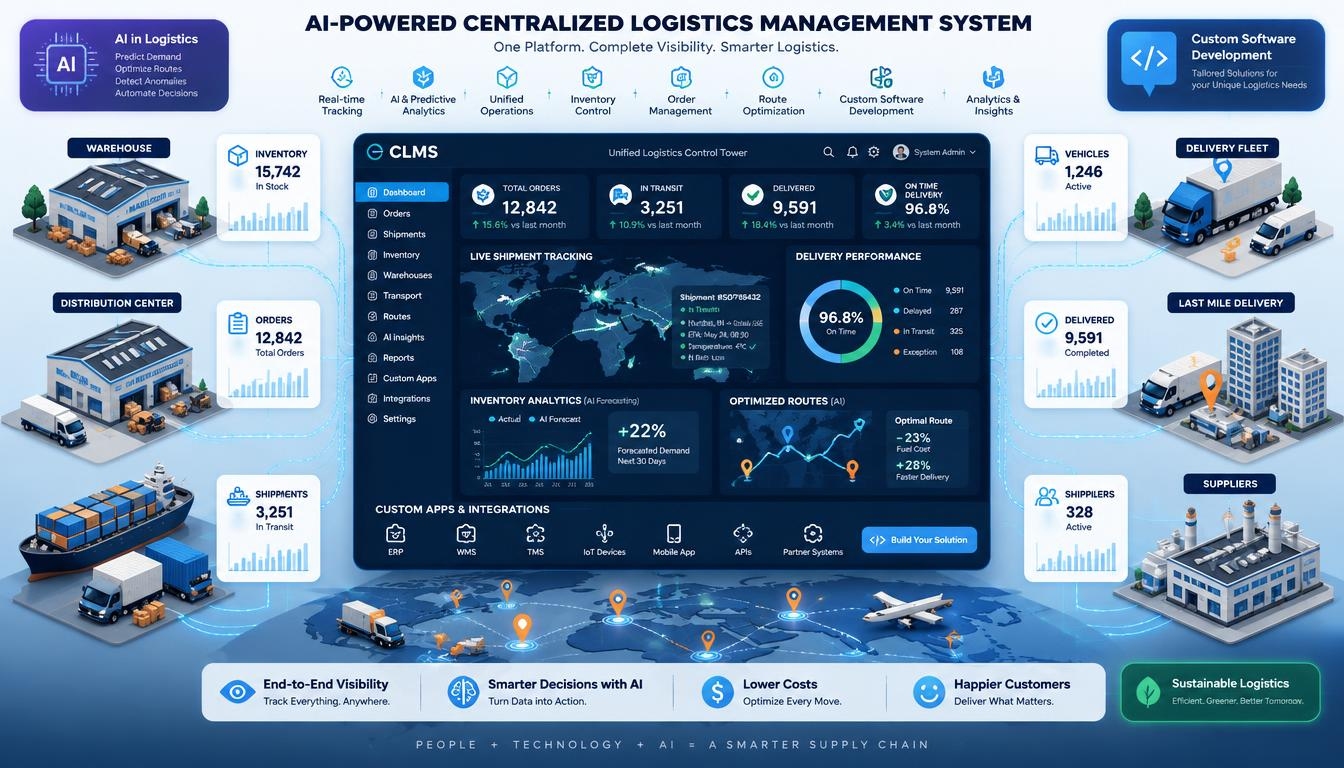
1. What Is a Centralized Logistics Management System?
A centralized logistics management system is a software platform that connects different logistics operations through a single application.
Instead of managing shipment bookings, driver assignments, vehicle information, warehouse inventory and invoices in separate systems, businesses can access these operations through one central interface.
Depending on the business model, the platform may support:
- Logistics and transportation companies
- Freight forwarding businesses
- Third-party logistics (3PL) providers
- E-commerce fulfilment companies
- Courier and delivery businesses
- Warehouse and distribution operators
- Manufacturers managing their own supply chains
For example, when a customer creates a shipment request, the system can record the booking, assign a suitable vehicle, notify the driver, track the shipment and update the customer as the delivery progresses.
Every department works with the same operational information, reducing communication gaps and duplicated data entry.
2. Why Do Logistics Businesses Need Centralized Software?
Many logistics businesses still depend on spreadsheets, phone calls, email communication and disconnected applications to manage daily operations.
These methods may work when operations are small, but they become difficult to maintain as shipment volumes and business complexity increase.
Some common challenges include:
Disconnected operational data: Booking, fleet, warehouse and billing information may be stored in different systems.
Limited shipment visibility: Customers and operations teams may not have access to accurate delivery updates.
Manual vehicle allocation: Dispatch teams spend time identifying available vehicles and assigning drivers.
Delayed communication: Changes in delivery schedules or shipment status may not reach all relevant people.
Difficult reporting: Management may struggle to understand delivery performance, vehicle utilization and operating costs.
Increasing administrative work: Repetitive tasks such as invoice generation, document handling and status notifications consume employees’ time.
A centralized platform addresses these challenges by connecting the main business processes and providing a consistent view of operations.
3. Essential Features of a Logistics Management System
The exact functionality depends on the business, but most comprehensive logistics platforms require several core modules.
3.1 Centralized Dashboard
The dashboard provides an overview of business operations.
It can display:
- Total shipments and active deliveries
- Pending and completed bookings
- Available and assigned vehicles
- Driver availability
- Delayed shipments
- Warehouse activity
- Revenue and outstanding invoices
- Operational performance indicators
Role-based dashboards can provide different information to administrators, dispatchers, warehouse managers, drivers and customers.
3.2 Shipment and Booking Management
Shipment management is one of the most important modules.
Customers or internal employees should be able to create shipment requests by entering pickup and delivery locations, shipment details, package dimensions, weight and preferred delivery dates.
The system can manage:
- New shipment requests
- Pickup and delivery schedules
- Shipment status
- Customer information
- Freight charges
- Delivery instructions
- Shipment documents
- Cancellation and rescheduling
Each shipment should have a unique reference number that can be used across the platform.
3.3 Fleet and Driver Management
A fleet management module helps businesses manage vehicles, drivers and transportation resources.
Important capabilities include:
- Vehicle registration and documentation
- Vehicle availability
- Driver profiles and assignments
- Vehicle maintenance schedules
- Fuel and operating expense records
- Trip history
- Vehicle utilization reports
- Driver performance monitoring
The system can also maintain vehicle capacity information to help dispatchers select appropriate vehicles for different shipments.
3.4 Real-Time Shipment and Vehicle Tracking
Real-time tracking gives businesses visibility into shipment movement.
A vehicle’s GPS-enabled mobile application or telematics device can transmit location updates to the platform. The system can display these updates on an interactive map.
Tracking functionality may include:
- Current vehicle location
- Shipment movement history
- Estimated arrival time
- Pickup and delivery status
- Geofence notifications
- Route deviation alerts
- Proof of delivery
Mapping services such as Google Maps Platform or Mapbox can provide map rendering, geocoding and routing capabilities.
The accuracy of estimated arrival times depends on location frequency, traffic information, route conditions and the quality of the underlying data.
3.5 Warehouse and Inventory Management
For businesses that operate warehouses, inventory and warehouse management can be integrated into the same platform.
Typical features include:
- Inbound shipment registration
- Outbound shipment processing
- Stock availability
- Storage location management
- Barcode scanning
- Picking and packing
- Inventory movement history
- Warehouse reports
Connecting warehouse operations with shipment management helps teams coordinate dispatch schedules and inventory availability.
3.6 Billing and Payment Management
Financial operations should also be connected with shipment records.
A billing module can support:
- Freight charge calculation
- Customer invoices
- Vendor payments
- Tax and additional charges
- Payment status
- Outstanding balances
- Financial reports
Automated invoice generation can reduce repetitive administrative work, provided that the system applies the correct pricing rules and tax calculations.
3.7 Document Management
Logistics operations involve a large number of documents, including invoices, delivery receipts, shipment labels, transport documents and proof-of-delivery records.
A centralized document module can store these files against the relevant shipment, customer, driver or vehicle.
Additional functionality may include document expiry reminders, access permissions, digital signatures and automated document extraction.
4. Recommended Technology Stack for Logistics Software Development
Choosing the right technology stack is an important part of building a logistics platform.
The system needs to support transactional operations, geospatial queries, live tracking, background processing and integrations with external services.
There is no single technology stack that is ideal for every logistics company. However, the following combination provides a strong foundation for a modern, scalable platform.
4.1 Frontend: React, Next.js and TypeScript
Recommended technologies: React + Next.js + TypeScript
The frontend is responsible for presenting operational information and allowing users to interact with the platform.
Next.js, built on React, is suitable for developing:
- Administrative dashboards
- Dispatcher interfaces
- Customer portals
- Shipment management screens
- Warehouse dashboards
- Reporting interfaces
TypeScript adds static typing, helping development teams maintain large applications and reduce errors as the system grows.
The frontend can also integrate interactive maps, data visualization libraries, notification panels and real-time tracking components.
Tailwind CSS can be used to build consistent and responsive interfaces.
4.2 Backend: Node.js and NestJS
Recommended technologies: Node.js + NestJS + TypeScript
The backend handles the main business logic and coordinates communication between different modules.
NestJS provides a structured application architecture with modules, dependency injection, validation, authentication, background processing integrations and WebSocket support.
It can be used to develop services for:
- Shipment management
- Booking and dispatch
- Fleet and driver management
- Customer management
- Billing and payments
- Warehouse operations
- Third-party integrations
- Notifications and reporting
A modular backend makes it easier to maintain individual business areas without unnecessarily separating the application into multiple independent services.
4.3 Database: PostgreSQL and PostGIS
Recommended technologies: PostgreSQL + PostGIS
A logistics platform manages structured information such as customers, shipments, vehicles, drivers, routes, invoices and warehouse records.
PostgreSQL is a strong choice for this type of transactional data.
PostGIS extends PostgreSQL with geospatial capabilities, which are particularly useful in logistics applications.
For example, the system can use geospatial queries to:
- Identify nearby available vehicles
- Calculate distances between locations
- Check whether a vehicle has entered a delivery area
- Identify shipments within a geographical region
- Analyze vehicle movement and delivery routes
For a platform that depends heavily on location information, this database combination provides a useful foundation.
4.4 Caching and Background Processing: Redis and BullMQ
Recommended technologies: Redis + BullMQ
Not every operation needs to be processed during a user’s request.
For example, sending notifications, generating reports, processing documents and synchronizing external shipment updates can happen in the background.
Redis can support caching and fast access to frequently changing information.
BullMQ can manage background jobs and queues, including:
- Shipment status notifications
- Scheduled reminders
- Invoice generation
- Document processing
- Data synchronization
- Periodic reporting
- Retry handling for failed jobs
This helps keep the main application responsive while longer-running operations are processed separately.
4.5 Mobile Application: React Native
Recommended technology: React Native
Drivers and field employees need mobile access to operational information.
A React Native application can provide a shared mobile development approach for Android and iOS.
Driver application features may include:
- Assigned shipment details
- Pickup and delivery instructions
- Navigation links
- Location sharing
- Delivery status updates
- Barcode scanning
- Photograph uploads
- Customer signatures
- Proof-of-delivery submission
Offline support is especially important when drivers operate in areas with unreliable internet connectivity.
The mobile application should temporarily store relevant actions and synchronize them with the server when connectivity becomes available.
4.6 Real-Time Communication: WebSockets
Recommended technologies: WebSockets with Socket.IO
Traditional request-and-response communication is not always sufficient for live logistics operations.
Dispatchers need to see vehicle movement, shipment status changes and delivery updates without repeatedly refreshing the page.
WebSockets allow the server to push updates to connected applications.
Possible applications include:
- Live vehicle tracking
- Shipment status updates
- Driver assignment notifications
- Dispatch alerts
- Delivery progress
- Real-time operational dashboards
Socket.IO can simplify event-based communication between the backend and frontend.
4.7 Maps, Routing and Geolocation
Recommended services: Google Maps Platform or Mapbox
Mapping technology is a key part of logistics software.
Depending on the project, mapping services can provide:
- Address search and geocoding
- Route calculation
- Distance estimation
- Travel-time estimation
- Interactive maps
- Location visualization
- Traffic information where supported
For more advanced route optimization, the platform can integrate optimization engines such as Google OR-Tools.
Route optimization should consider practical constraints such as vehicle capacity, delivery time windows, driver working hours, pickup priorities and delivery locations.
4.8 Cloud Infrastructure: AWS
Recommended platform: Amazon Web Services (AWS)
Cloud infrastructure provides the resources required to deploy and operate a logistics platform.
A possible AWS setup includes:
- Amazon ECS for containerized application deployment
- Amazon RDS for managed PostgreSQL
- Amazon S3 for shipment documents and uploaded files
- Amazon ElastiCache for Redis
- Amazon CloudFront for content delivery
- Amazon CloudWatch for monitoring and logs
- AWS IAM for access and permission management
Docker can package application components consistently across development and production environments.
Infrastructure as Code tools such as Terraform can help manage repeatable cloud deployments.
Kubernetes can be considered when the platform’s operational requirements justify its additional complexity. It is not a requirement for every logistics application.
5. How AI Can Improve Logistics Management
Artificial intelligence can add value when it is connected to actual operational data and business processes.
Instead of using AI only as a chatbot, logistics companies can apply it to forecasting, planning, document processing and operational decision support.
5.1 AI-Powered Booking Assistant
An AI assistant can help customers create shipment requests through natural language.
For example, a customer could enter:
“I need to transport 500 kg of goods from Jaipur to Delhi next Monday.”
The assistant can identify the requested locations, approximate shipment details and preferred date, then populate the booking form.
The customer or employee should review and confirm the information before the booking is finalized.
5.2 Predictive Delivery Estimates
Traditional delivery estimates often rely on fixed travel times or basic route calculations.
AI and machine learning models can use historical shipment data, traffic information, route conditions and delivery patterns to improve estimated arrival times.
The system can identify shipments that may be delayed and notify the operations team.
5.3 Route Optimization
AI-assisted optimization can help dispatchers identify efficient delivery routes.
The system may consider:
- Vehicle capacity
- Pickup and delivery locations
- Delivery deadlines
- Traffic conditions
- Driver availability
- Fuel and distance costs
- Multiple delivery stops
Optimization engines such as OR-Tools can handle constraint-based routing problems. Machine learning can complement these engines by providing better predictions of travel times and operational conditions.
5.4 Predictive Fleet Maintenance
Vehicle maintenance is another area where predictive analytics can be useful.
By analyzing maintenance history, mileage, vehicle usage and available telematics data, the system can identify vehicles that may require inspection or maintenance.
This can help businesses plan maintenance before a vehicle becomes unavailable during an important delivery.
5.5 AI-Based Document Processing
Logistics businesses regularly receive invoices, shipment receipts, delivery documents and other operational files.
AI-powered document processing can extract information such as:
- Shipment reference numbers
- Customer names
- Pickup and delivery addresses
- Invoice numbers
- Dates and amounts
- Package information
Extracted information can be sent for validation before being saved into the system.
This can reduce manual data entry, especially when documents come from multiple suppliers or customers.
5.6 Demand Forecasting
Machine learning models can analyze historical shipment volumes, seasonal patterns, customer activity and business trends.
The system can use these insights to support decisions about:
- Fleet capacity
- Warehouse space
- Staffing requirements
- Delivery schedules
- Inventory planning
Forecasts should be treated as decision-support information rather than guaranteed predictions.
6. Workflow Automation in Logistics Operations
Automation connects different modules and reduces repetitive manual work.
A well-designed logistics platform can automate several operational workflows.
Automated shipment processing: When a shipment request is approved, the system can create a shipment record, generate a reference number and notify the relevant team.
Vehicle assignment: The platform can identify suitable available vehicles based on capacity, location and delivery requirements.
Delivery notifications: Customers can receive updates when a shipment is booked, picked up, dispatched or delivered.
Invoice generation: Once the applicable shipment and pricing conditions are met, the system can generate an invoice for review or dispatch.
Document reminders: The system can alert administrators about expiring vehicle documents, insurance or other required records.
Exception management: Delayed shipments, failed deliveries and route deviations can generate alerts and create follow-up tasks.
Automation rules should include validation, permissions and appropriate human approval for sensitive actions such as payment processing, shipment cancellation and financial adjustments.
7. Suggested Architecture of a Centralized Logistics Platform
A modern logistics application should be designed with clearly separated responsibilities.
A practical architecture can be organized into the following layers.
Frontend Layer
- Next.js
- React
- TypeScript
- Tailwind CSS
- Interactive mapping components
This layer supports administrators, dispatchers, customers and operations teams.
Backend Application Layer
- Node.js
- NestJS
- REST APIs
- WebSocket gateways
- Authentication and role-based permissions
This layer manages the main business rules and coordinates communication between modules.
Data Layer
- PostgreSQL
- PostGIS
- Redis
- Amazon S3
PostgreSQL stores business records, PostGIS handles geographical queries, Redis supports caching and background jobs, and S3 stores documents and files.
Mobile Layer
- React Native
- GPS and location services
- Camera and barcode scanning
- Offline data synchronization
This layer supports drivers and field employees.
AI and Automation Layer
- Python-based machine learning services
- AI model APIs
- Document extraction
- Predictive analytics
- Workflow automation
Python can be introduced as a separate service where specialized data processing or machine learning is needed. It does not need to handle every backend operation.
Infrastructure and Deployment Layer
- AWS
- Docker
- CI/CD pipelines
- Monitoring and logging
- Automated backups
- Security and access controls
This architecture provides a clear separation between business operations, data management, mobile access and intelligent automation.
For an initial implementation, a modular backend with background workers is generally a sensible starting point. Event streaming tools such as Apache Kafka or Amazon Kinesis can be introduced later if the platform needs to process a high volume of events from vehicles, carriers and external systems.
8. Important Third-Party Integrations
A logistics platform rarely operates independently. It often needs to exchange information with other business systems.
Common integrations include:
Mapping and navigation: Google Maps Platform, Mapbox or HERE.
Payment gateways: Stripe, Razorpay or other payment providers depending on the target market.
Communication: Email, SMS and WhatsApp Business integrations.
Accounting and ERP: Integration with existing accounting, invoicing and enterprise resource planning systems.
Carrier and shipping APIs: External carrier APIs for rates, labels, tracking and shipment updates.
Telematics and IoT: Vehicle GPS devices, temperature sensors and other monitoring equipment.
Identity and authentication: Secure authentication, multi-factor authentication and role-based access controls.
Integration requirements should be identified early because external API limitations, data formats and vendor dependencies can affect the overall architecture.
9. Security and Scalability Considerations
A logistics platform may contain sensitive customer details, business records, financial information and real-time location data.
Security should be part of the system design from the beginning.
Important considerations include:
- Role-based access control
- Secure authentication and session management
- Encryption in transit and at rest
- API authentication and rate limiting
- Audit logs for important actions
- Secure document access
- Database backups and recovery procedures
- Monitoring and error tracking
- Data retention policies
- Tenant-level data isolation for multi-customer SaaS platforms
Scalability should also be considered during development.
For example, the system may initially support a few hundred shipments per day, but later need to handle thousands of shipments and frequent vehicle location updates.
The architecture should allow individual components to be improved as demand increases, without requiring a complete rewrite.
10. How to Develop a Logistics Management System Step by Step
Building a complete logistics platform in one phase can be expensive and difficult to manage.
A phased development approach allows businesses to launch essential functionality first and expand based on actual operational requirements.
Phase 1: Requirement Analysis and Planning
Identify business workflows, user roles, shipment types, fleet requirements, integrations and reporting needs.
Phase 2: Core Platform Development
Build authentication, user management, customer records, shipment booking, fleet management and the main administrative dashboard.
Phase 3: Tracking and Mobile Applications
Introduce GPS tracking, driver applications, shipment status updates and proof-of-delivery functionality.
Phase 4: Billing and Integrations
Add invoicing, payment integrations, carrier APIs, notifications and document management.
Phase 5: AI and Automation
Introduce predictive delivery estimates, document extraction, route optimization and intelligent booking assistance where suitable data and workflows are available.
Phase 6: Testing and Deployment
Perform functional, security, performance and integration testing. Deploy the platform with monitoring, backups and operational support.
This approach gives businesses a usable foundation while keeping future development flexible.
11. Custom Logistics Software vs Ready-Made Solutions
Businesses can choose between adopting an existing logistics product and developing a custom platform.
Ready-made software can be a good option when standard functionality meets most business requirements.
However, businesses with specialized workflows, multiple operating models, unique pricing structures or complex integrations may need a custom solution.
| Area | Ready-Made Software | Custom Logistics Platform |
|---|---|---|
| Initial setup | Usually faster | Requires development |
| Custom workflows | Depends on product | Designed around business needs |
| Integrations | Limited to available options | Can be built around required systems |
| Ownership and control | Depends on vendor | Greater control over application |
| Scalability | Depends on vendor plans | Can be designed for expected growth |
| Initial investment | Often subscription-based | Higher initial development effort |
The right choice depends on business size, operational complexity, budget and long-term requirements.
12. How Xenixsoft Can Help Build Custom Logistics Software
Developing a logistics management platform requires an understanding of business workflows, application architecture, data management, integrations and automation.
At Xenixsoft, we work on custom web applications and business systems designed around specific operational requirements.
Our development capabilities include:
- Custom logistics and business management applications
- React and Next.js frontend development
- Node.js and NestJS backend development
- Python-based AI and automation services
- Database architecture and API integrations
- Real-time dashboards and tracking interfaces
- Cloud deployment and application maintenance
Whether a business needs a shipment booking platform, fleet management application, centralized logistics dashboard or a complete logistics management system, the architecture should be planned around its actual operational needs.
We focus on building systems that can evolve as business requirements and transaction volumes grow.
Conclusion
A centralized logistics management system can help businesses bring shipment booking, fleet management, warehouse operations, tracking, billing and customer communication into one connected platform.
Modern technologies such as Next.js, NestJS, PostgreSQL, PostGIS, Redis and React Native provide a strong foundation for developing these applications. Cloud infrastructure, real-time communication and well-designed integrations make it possible to support increasingly complex logistics operations.
AI and automation can add further value through predictive delivery estimates, route optimization, document processing and intelligent workflows. However, these capabilities should be introduced where they solve real operational problems.
The most effective logistics platform is not necessarily the one with the largest number of technologies. It is the one that connects business operations reliably, provides useful information and can grow with the organization.