
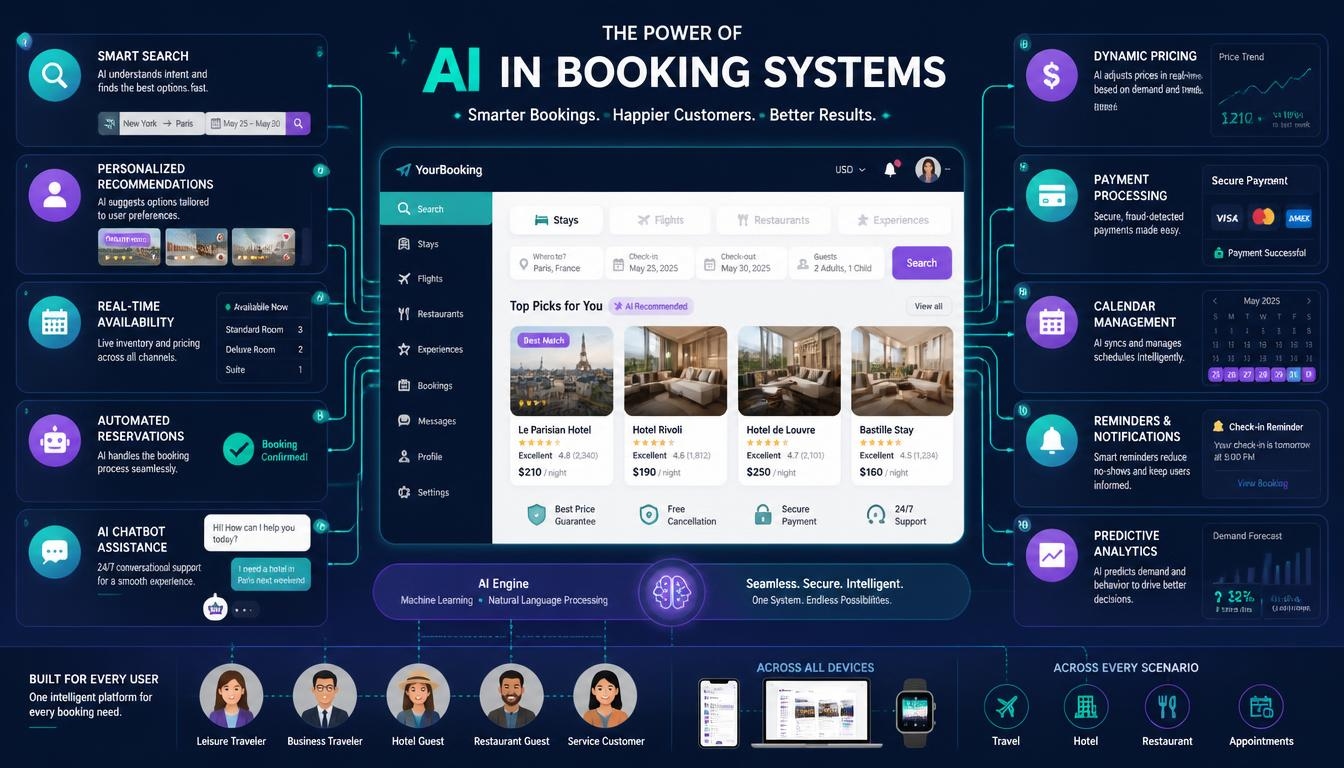
What Is an AI-Powered Booking System?
An AI-powered booking system is a reservation or scheduling platform that uses artificial intelligence to automate tasks, understand customer requests, analyze booking patterns, and provide personalized recommendations.
A traditional booking platform primarily follows predefined rules. Customers select a service, choose an available date and time, enter their details, and confirm the reservation.
An AI-powered system can go further by understanding what customers actually need and helping them complete the process.
For example, a customer might ask:
“I need a hotel room near the airport for two nights next weekend, preferably with breakfast and parking.”
Instead of requiring the customer to apply several filters manually, an AI booking assistant can interpret the request, identify suitable options, check availability, and present relevant choices.
Depending on the system’s capabilities and permissions, it may also help complete the reservation.
How AI Is Used in Modern Booking Systems
AI can improve several stages of the booking process, from the first customer interaction to post-booking support.
1. AI-Powered Booking Assistants
One of the most visible applications of AI in booking systems is the intelligent booking assistant.
Traditional booking forms require customers to navigate menus and enter information step by step. An AI assistant allows them to communicate using everyday language.
For example:
- “Book a dental appointment for Monday afternoon.”
- “Find a restaurant for four people this Friday.”
- “I need a hotel room with a swimming pool.”
- “Reschedule my appointment to next week.”
The AI assistant interprets the request, asks for missing information, checks available options, and guides the customer through the booking process.
This makes the booking experience more conversational and convenient.
2. Personalized Recommendations
AI can analyze previous bookings, customer preferences, search behavior, and other permitted information to recommend relevant services.
For example, a hotel booking platform may recommend properties based on a customer’s preferred location, room type, budget, and previous choices.
A restaurant reservation platform may suggest restaurants based on cuisine preferences, group size, location, and previous reservations.
Personalization can reduce the time customers spend searching and help businesses present more relevant options.
3. Smart Scheduling and Automatic Availability Management
Managing appointments and reservations can become complicated when businesses have multiple staff members, rooms, resources, or service locations.
AI can help analyze scheduling requirements and identify suitable time slots.
For example, in a healthcare appointment system, intelligent scheduling could consider:
- Doctor availability
- Appointment duration
- Type of consultation
- Existing patient appointments
- Equipment or room availability
- Urgency and scheduling rules
The system can recommend suitable slots while respecting business-defined constraints.
This can help reduce scheduling conflicts and improve resource utilization.
4. Predictive Demand and Dynamic Pricing
AI can analyze historical booking data, seasonal trends, customer behavior, local events, and other relevant signals to estimate future demand.
Hotels, airlines, travel companies, and event organizers can use these insights to make better pricing and capacity decisions.
For example, a hotel may observe that room demand increases during a major local event. A predictive system can help the business anticipate higher occupancy and adjust its pricing strategy.
Dynamic pricing should remain subject to business rules, transparency, and applicable consumer protection requirements.
5. Automated Booking Changes and Cancellations
Customers frequently need to change appointment times, modify reservations, or cancel bookings.
AI assistants can understand these requests and guide customers through the relevant process.
For example:
“I cannot attend my appointment tomorrow. Can you move it to Thursday morning?”
The system can identify the existing booking, check alternative slots, explain any applicable cancellation or rescheduling conditions, and request confirmation before making changes.
This reduces routine administrative work and makes customer support more accessible.
6. AI-Powered Customer Support
Booking-related questions often involve availability, pricing, cancellation policies, payment status, directions, and confirmation details.
An AI support assistant can answer many routine questions by retrieving information from the booking platform and its connected knowledge base.
It can help customers:
- Check reservation details
- Understand booking policies
- Find available dates
- Receive confirmation information
- Request changes
- Get answers to common questions
For complex cases, payment disputes, or unusual requests, the system should transfer the conversation to a human support representative.
7. Reducing No-Shows Through Predictive Analytics
Missed appointments can create financial losses and wasted resources, particularly in healthcare, salons, consulting, and other appointment-based businesses.
AI can analyze historical appointment patterns to estimate the likelihood of a missed appointment.
A booking platform could use these predictions to support actions such as:
- Sending reminders at appropriate intervals
- Offering easy rescheduling
- Requesting confirmation for selected appointments
- Managing waiting lists
- Identifying appointment slots that may need additional attention
Predictions should be used carefully. Businesses should avoid unfairly penalizing customers based solely on an automated risk score.
8. Voice-Based Booking
Voice interfaces are another emerging application of AI in booking platforms.
Customers may be able to speak naturally instead of typing information into a form.
For example:
“Find a table for two at an Italian restaurant tomorrow at seven.”
A voice-enabled booking assistant can convert speech into structured information, check availability, and guide the customer through confirmation.
This can make booking more accessible and convenient, especially for customers who prefer speaking over navigating complex interfaces.
Industry-Wise Applications of AI in Booking Systems
AI-powered booking technology is not limited to one industry. Different businesses can use it to solve different scheduling and reservation challenges.
Healthcare and Medical Appointments
Healthcare booking platforms can use AI to help patients find suitable doctors, understand available appointment options, and manage schedules.
Potential applications include intelligent appointment recommendations, automated reminders, cancellation management, and integration with patient management systems.
Clinical urgency and medical triage require appropriate professional oversight; a general booking assistant should not independently make medical decisions.
Hotels and Hospitality
Hotels can use AI to personalize room recommendations, answer guest questions, predict occupancy, and assist with reservation changes.
AI assistants can also support pre-arrival communication and help guests understand available hotel services.
Restaurants and Food Services
Restaurant reservation systems can use AI to manage table availability, handle booking requests, understand group requirements, and reduce missed reservations.
An intelligent system could also recommend suitable seating times based on party size and reservation patterns.
Travel and Transportation
Travel platforms can use AI to help customers compare travel options, organize itineraries, manage reservations, and receive assistance when schedules change.
AI can also help analyze demand and support operational planning.
Salons, Fitness and Professional Services
Appointment-based businesses can use AI to manage staff schedules, recommend available slots, send reminders, and handle rescheduling requests.
For businesses with multiple employees and service categories, intelligent scheduling can help coordinate availability more effectively.
Benefits of AI-Powered Booking Systems
AI can provide value to both businesses and customers when implemented with appropriate controls.
Improved Customer Experience: Customers can describe what they need naturally and receive relevant booking options without navigating complicated forms.
Reduced Administrative Work: Routine booking questions, reminders, and schedule changes can be automated.
Better Resource Utilization: Intelligent scheduling can help businesses coordinate employees, rooms, equipment, and available time slots.
More Personalized Services: Recommendations can be based on relevant customer preferences and booking history.
Improved Demand Planning: Predictive analytics can help businesses anticipate busy periods and make better operational decisions.
Continuous Customer Assistance: AI assistants can handle routine requests outside normal business hours, subject to system availability and escalation arrangements.
Challenges of Implementing AI in Booking Platforms
Although AI offers significant opportunities, businesses need to consider several technical and operational challenges.
Data Privacy and Security
Booking platforms may process names, contact details, payment information, travel plans, and sensitive appointment information.
AI integrations must follow appropriate data protection practices, including secure storage, access controls, encryption, and responsible data processing.
Integration With Existing Systems
Many businesses already use booking software, payment gateways, CRM platforms, calendars, and customer management tools.
AI functionality must integrate reliably with these systems to access accurate information and perform authorized actions.
Incorrect Availability or Booking Information
An AI assistant should never invent available time slots, prices, or reservation confirmations.
It must retrieve live information from the actual booking system and verify availability before confirming a reservation.
Human Oversight
AI can misunderstand requests or encounter unusual booking situations.
Businesses should provide a clear option to contact human staff, especially when dealing with payments, disputes, complex changes, or important customer requirements.
Development and Maintenance Costs
AI implementation involves more than connecting a chatbot to a website. It may require data integration, model selection, workflow development, security testing, monitoring, and ongoing maintenance.
Businesses should begin with applications that solve measurable problems rather than adding AI features without a clear purpose.
The Future of AI in Booking Systems
AI is likely to change booking systems from simple reservation tools into intelligent platforms that can understand customer requirements, coordinate resources, and manage more of the booking journey.
Several developments are particularly important.
1. Autonomous AI Booking Agents
Future booking platforms may use AI agents that can manage multi-step reservation tasks with limited human intervention.
For example, a customer might say:
“Arrange a business trip to London next month. I need a hotel near the conference venue and a return flight.”
An AI agent could help compare suitable options, check availability, organize the itinerary, and prepare reservations for approval.
With appropriate permissions, payment controls, and confirmation steps, some of these actions could be completed automatically.
2. Conversational Booking Across Multiple Channels
Booking experiences may become less dependent on traditional websites and mobile applications.
Customers could make reservations through messaging platforms, voice assistants, business websites, or other connected interfaces.
The same booking information could be accessed across these channels, allowing customers to start a request in one place and continue it somewhere else.
3. Proactive and Predictive Scheduling
Instead of waiting for customers to search for appointments, future systems may proactively suggest suitable times based on customer preferences and available schedules.
For example, a service platform could notify a customer when a preferred appointment slot becomes available after a cancellation.
Healthcare and other appointment-based organizations may also use predictive scheduling to plan staff and resources more effectively.
4. Personalized Booking Experiences
AI systems may increasingly understand individual preferences and use them to simplify repeat bookings.
A returning hotel guest might receive room recommendations based on previous stays, while a regular salon customer could be shown their preferred service and stylist.
Personalization will need to balance convenience with customer consent and data privacy.
5. Integration With Smart Devices and Connected Services
Wearables, smart assistants, connected vehicles, and other devices may become additional ways to initiate or manage bookings.
For example, a connected service could remind a customer to schedule a maintenance appointment or suggest a suitable time based on their calendar.
These experiences will depend on reliable integrations and appropriate permission management.
6. AI-Powered Booking Platforms That Manage Entire Workflows
One of the biggest developments may be the move from AI-assisted booking to broader workflow automation.
Instead of simply reserving a time slot, an intelligent platform could coordinate related activities such as:
- Checking customer eligibility
- Collecting required information
- Verifying availability
- Processing authorized payments
- Sending confirmations
- Updating CRM records
- Managing reminders
- Handling post-booking communication
This could turn a booking platform into a more complete business operations system.
How Businesses Can Prepare for the Future
Businesses do not need to replace their entire booking infrastructure to benefit from AI.
A practical implementation approach can begin with a few focused improvements:
- Review the existing booking process: Identify repetitive tasks, customer complaints, scheduling conflicts, and operational bottlenecks.
- Improve booking data: Maintain accurate service information, availability, pricing, customer records, and reservation status.
- Introduce an AI booking assistant: Start with customer queries, service discovery, and availability checks.
- Connect existing business systems: Integrate booking software with calendars, CRM platforms, payment systems, and notification services.
- Automate selected workflows: Add rescheduling, reminders, cancellation handling, and other approved actions.
- Measure performance: Track booking completion rates, missed appointments, support workload, customer satisfaction, and operational efficiency.
Starting with clearly defined workflows makes it easier to evaluate the business value of AI before expanding its role.
Conclusion
AI is changing the way booking systems operate. What once required customers to navigate forms, search manually, and contact support can increasingly be handled through intelligent assistants, automated scheduling, and personalized recommendations.
For businesses, these technologies offer opportunities to reduce administrative work, improve resource utilization, and provide more responsive customer experiences.
The next generation of booking platforms will likely go beyond accepting reservations. They will understand customer requests, coordinate multiple services, anticipate scheduling requirements, and automate complete booking workflows.
Businesses that build reliable booking infrastructure and integrate AI thoughtfully will be better positioned to take advantage of these developments.
The future of booking is not simply about making reservations online. It is about making the entire process more intelligent, connected, and convenient.