
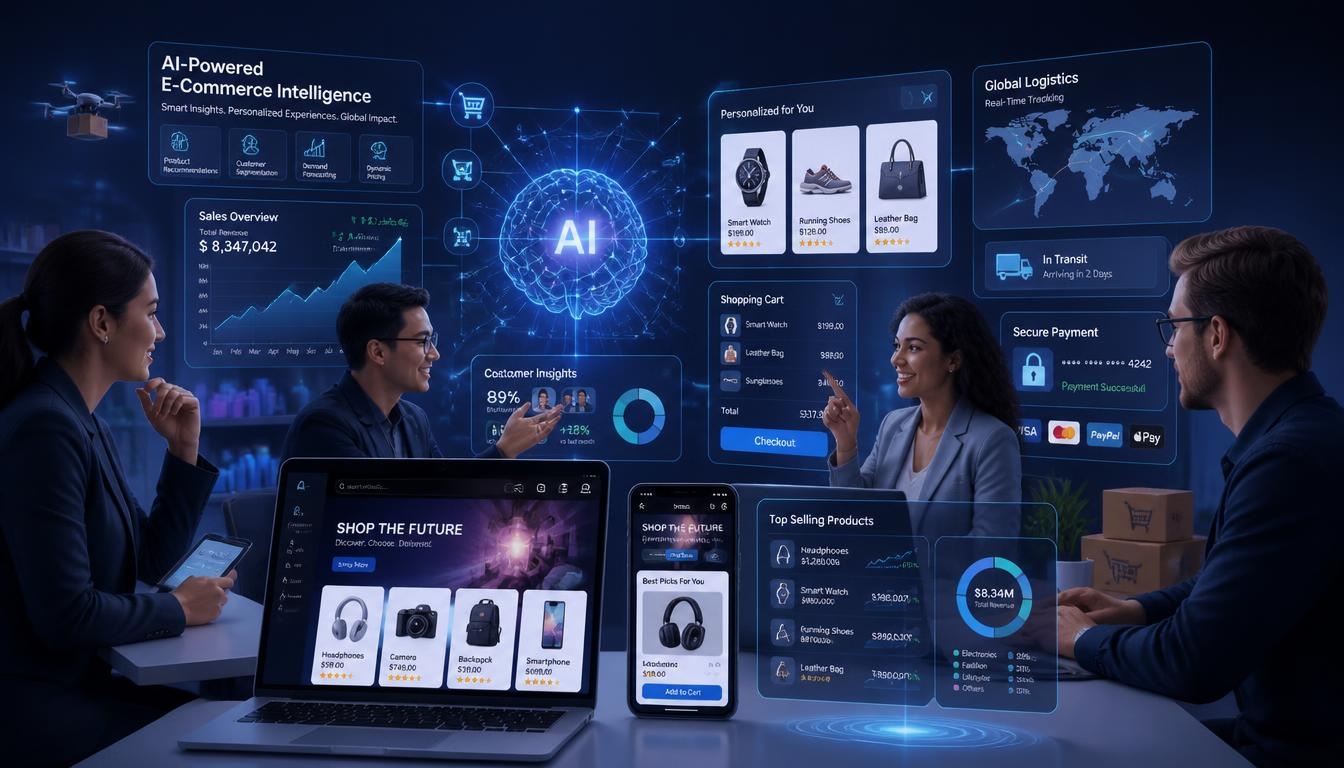
Understanding AI Automation in E-Commerce
AI automation combines artificial intelligence with software systems and business workflows to perform activities that would otherwise require repeated manual intervention.
Traditional automation generally operates according to predefined instructions. For example, an e-commerce platform might automatically send an order confirmation after a successful purchase or notify an administrator when inventory falls below a specified quantity.
AI extends these capabilities by helping systems interpret information, recognize patterns, and respond to situations that cannot always be addressed through fixed rules alone.
An AI-powered system might analyze purchasing trends, identify products that are likely to experience increased demand, recommend inventory adjustments, or assist customers with questions about suitable products.
These capabilities become particularly useful when connected to existing e-commerce platforms, customer databases, inventory applications, and order management systems.
The objective is to reduce unnecessary administrative work and help businesses make more informed decisions without losing control over important operations.
How AI Is Changing E-Commerce Operations
AI is already being applied across several areas of online retail. Some applications are visible to customers, while others work behind the scenes to improve operational efficiency.
Personalized Shopping Experiences
Customers visiting an online store do not necessarily have the same requirements or purchasing interests.
AI-powered recommendation systems can analyze browsing activity, purchase history, product relationships, and other permitted information to suggest relevant products.
For example, a customer browsing professional photography equipment might receive recommendations for compatible lenses, accessories, or related products rather than unrelated items from the store’s wider catalogue.
When implemented carefully, personalization can make product discovery easier and help customers find suitable options without navigating through hundreds of listings.
However, personalization should remain transparent and respect customer privacy. Recommendations should assist purchasing decisions rather than manipulate them.
Automated Customer Support
Customer service is one of the most time-consuming responsibilities for growing e-commerce businesses.
Questions about delivery times, product availability, return policies, order status, and payment issues frequently require employees to retrieve information from different systems.
AI-powered support assistants can help manage these enquiries by connecting with product catalogues, order management systems, and approved business documentation.
A customer asking about a delayed delivery, for example, could receive an update based on actual order and shipping information instead of a generic response.
More complicated situations, such as disputed payments or unusual refund requests, can be transferred to a human support representative.
This approach allows businesses to automate routine enquiries while maintaining appropriate oversight of sensitive customer interactions.
Inventory and Demand Forecasting
Maintaining the right inventory balance is an ongoing challenge for online retailers.
Excess inventory increases storage costs and ties up working capital, while insufficient stock can lead to missed sales and dissatisfied customers.
AI can support inventory planning by examining historical sales, seasonal patterns, purchasing behavior, and other relevant business information.
A retailer might use these insights to identify products that are likely to experience higher demand during a particular period and plan purchasing accordingly.
Forecasting is never completely accurate, particularly when market conditions change unexpectedly. However, combining AI-generated predictions with business experience can provide a stronger basis for inventory decisions.
Product Information and Catalogue Management
Managing product information becomes increasingly difficult as an online store expands.
Each product may require descriptions, specifications, categories, images, variations, pricing information, and search-related metadata.
AI can assist by extracting information from supplier documents, organizing product attributes, identifying missing details, and preparing descriptions based on verified information.
For marketplaces that allow independent sellers to create listings, AI can also simplify the submission process.
A seller could upload a product photograph or provide a short description, allowing the system to suggest an appropriate category and populate relevant listing fields.
The seller or administrator would then review the generated information before publication.
This reduces repetitive data entry while helping maintain consistency across a large product catalogue.
The Role of AI Agents in E-Commerce
AI agents introduce another level of capability by connecting intelligent systems with the tools required to complete defined business tasks.
Unlike a standalone chatbot that primarily answers questions, an AI agent can be designed to retrieve information, interact with connected applications, and carry out a sequence of permitted actions.
Consider an online retailer receiving a customer request to exchange a product.
An AI agent could retrieve the order details, check the applicable return policy, verify whether the requested replacement is available, and prepare an exchange request.
Depending on the company’s approval rules, the system could either complete the permitted steps or forward the request to an employee for confirmation.
Other applications may include monitoring inventory alerts, preparing supplier communications, organizing customer feedback, or identifying orders that require additional attention.
The value of these systems depends on their integration with actual business processes. An agent that produces useful suggestions but cannot access accurate operational information may offer limited practical benefit.
AI Employees and Connected E-Commerce Workflows
As businesses introduce AI across different departments, they may begin organizing these capabilities around broader operational responsibilities.
An AI employee is a role-based system that combines multiple AI capabilities to support a recognizable business function.
For example, an AI catalogue management assistant might handle several related activities, including reviewing newly submitted products, identifying incomplete information, suggesting categories, and preparing listings for approval.
A separate AI customer service assistant could coordinate order enquiries, retrieve relevant policies, summarize unresolved complaints, and maintain support records.
These systems can also exchange information through connected workflows.
If repeated customer complaints indicate a possible product issue, a support workflow could flag the pattern for the catalogue or operations team. The business could then investigate whether the listing, product information, or fulfilment process requires attention.
This illustrates how AI automation can develop beyond individual tasks into a more connected approach to e-commerce management.
Human employees remain responsible for business decisions, exceptions, customer relationships, and activities requiring judgment or accountability.
AI Automation in Order Processing and Fulfilment
Order management involves several connected stages, from payment confirmation and inventory allocation to packaging, shipping, delivery, and returns.
Although many of these activities already use conventional automation, AI can provide additional support when processes involve incomplete information, exceptions, or changing conditions.
For example, AI systems can help identify orders with unusual characteristics, organize delivery-related enquiries, detect recurring fulfilment problems, and summarize issues requiring operational attention.
Businesses operating across multiple warehouses or sales channels may also use predictive systems to support inventory allocation and replenishment planning.
However, financial transactions, stock adjustments, and shipping decisions must remain subject to appropriate validation and business rules.
AI should improve the reliability of existing processes rather than introduce uncertainty into activities that require precise execution.
AI-Powered Marketing and Customer Retention
Marketing is another area where e-commerce businesses can benefit from AI automation.
Online retailers often manage product campaigns, email communications, promotional content, customer segmentation, and performance reporting across several platforms.
AI can assist with analyzing campaign results, organizing customer groups, preparing content variations, and identifying opportunities to improve communication.
For example, a business could use AI to examine purchasing patterns and identify customers who may benefit from relevant product updates or replenishment reminders.
It could also analyze customer reviews and support enquiries to identify recurring concerns that should be addressed in product descriptions or marketing materials.
The important consideration is relevance.
Generating more promotional messages does not automatically improve marketing performance. AI should help businesses communicate more effectively while respecting customer preferences, consent, and applicable privacy requirements.
Can AI Help Reduce E-Commerce Operating Costs?
Cost reduction is one of the main reasons businesses explore AI automation, but its financial value depends on the processes being automated.
An online store handling a small number of daily orders may not need a complex AI infrastructure. A larger retailer processing thousands of enquiries, product updates, and transactions may find considerably more opportunities to reduce repetitive work.
Potential operational improvements include:
- Reducing manual product data entry and catalogue maintenance.
- Handling routine customer enquiries more efficiently.
- Improving inventory planning and reducing avoidable stock problems.
- Identifying operational issues earlier.
- Reducing time spent preparing reports and reviewing business information.
- Helping existing teams manage higher transaction volumes.
These benefits should be evaluated against implementation costs, ongoing model usage, integration requirements, maintenance, and human review.
A successful AI automation project should solve a measurable business problem rather than introduce additional technology without a clear operational purpose.
Challenges of Implementing AI in E-Commerce
Although AI offers considerable opportunities, introducing it into an existing e-commerce business requires careful planning.
Data Accuracy and System Integration
AI systems depend on the information available to them. Incorrect product details, outdated inventory records, or incomplete customer information can produce unreliable results.
Businesses should review their existing data and ensure that connected systems provide accurate, appropriately controlled information.
Customer Privacy and Security
E-commerce applications process sensitive information, including customer identities, addresses, order histories, and payment-related records.
AI integrations must follow appropriate security practices, including access restrictions, secure communication, data minimization, and activity monitoring.
Systems should not receive unrestricted access to customer or business information simply because they are capable of processing it.
Reliability and Human Oversight
AI-generated information can contain errors. A system might recommend an unsuitable product, misunderstand a return request, or incorrectly interpret information from a supplier document.
Businesses need validation procedures and clear rules for determining when a task can be completed automatically and when employee approval is required.
Implementation and Maintenance
AI automation is not necessarily a one-time development activity.
Changes to business processes, product catalogues, connected APIs, and underlying AI models can affect system performance.
Ongoing testing, monitoring, and maintenance are essential for keeping automation reliable as the business evolves.
The Future of AI in E-Commerce Business
The next stage of e-commerce development is likely to involve closer integration between AI systems and the applications businesses already use.
Rather than operating as separate tools, AI capabilities can become part of the everyday workflows through which retailers manage customers, products, inventory, marketing, and fulfilment.
Several developments are particularly relevant.
Conversational and Assisted Shopping
Customers may increasingly interact with online stores through conversational interfaces that help them compare products, explain requirements, and narrow down purchasing options.
Instead of navigating multiple filters and product pages, a shopper could describe what they need and receive relevant suggestions based on actual catalogue information.
More Connected Business Automation
AI agents may coordinate activities across different departments, reducing the need for employees to repeatedly transfer information between disconnected applications.
For example, information from customer support could help identify product listing problems, while inventory data could inform marketing and purchasing decisions.
Improved Operational Forecasting
As AI systems gain access to more reliable business information, they can support increasingly detailed forecasting and operational analysis.
Retailers may use these capabilities to better understand demand, identify emerging issues, and make timely decisions about stock, fulfilment, and customer service.
Greater Focus on Human and AI Collaboration
The future of e-commerce is unlikely to depend on removing people from every business process.
Instead, businesses can use AI to manage repetitive and information-intensive activities while employees focus on customer relationships, supplier management, product strategy, and decisions that require experience and judgment.
Preparing Your E-Commerce Business for AI Automation
Businesses considering AI automation should begin by examining their current operations.
Identify the activities that consume the most time, involve repeated manual work, or regularly create delays. These may include customer enquiries, catalogue updates, inventory monitoring, order administration, or internal reporting.
Once a suitable process has been identified, the next step is to determine what information the AI system requires, which applications it needs to access, and how its performance will be evaluated.
Starting with a focused implementation makes it easier to test reliability, understand costs, and measure improvements before introducing automation across additional business functions.
AI automation does not require every business to rebuild its existing e-commerce platform. In many cases, intelligent capabilities can be introduced through carefully designed integrations with the systems already in place.
Conclusion
AI automation is becoming an increasingly important part of modern e-commerce, offering businesses new ways to manage operational complexity and improve the online shopping experience.
From personalized product discovery and customer support to inventory planning, catalogue management, and connected business workflows, its applications extend across nearly every stage of online retail.
However, the value of AI should be measured by the problems it solves, not by the number of automated features a business introduces.
Retailers that combine reliable technology, accurate information, sensible automation, and human expertise will be better positioned to adapt as e-commerce continues to evolve.